Building only one hand: catalysis without metals
Awarded to Benjamin List and David W.C. MacMillan “for the development of asymmetric organocatalysis”.
1Pick your depth
What was the 2021 Nobel Prize in Chemistry awarded for?
The 2021 Chemistry prize honours a third kind of catalyst. Many molecules come in two mirror-image forms, like a left and a right hand, and often only one of them is useful or safe. Benjamin List and David MacMillan showed that small, cheap organic molecules can build just the hand you want, without the toxic metals or delicate enzymes chemists had relied on.
2Guess first
Your left and right hands are built from exactly the same parts, yet a right glove will not fit your left hand. Many molecules share this quirk. Why would a drug company care which 'hand' of a molecule it makes?
How close were you?
For about a century, chemists believed only two kinds of substance could reliably speed up reactions and pick one mirror image. List and MacMillan added a third. What was it?
How close were you?
3Learn it at ELI5
ELI5 done
Read the transcript
Benjamin List sat in a café with his wife, when his phone showed the word Sweden. It was the Nobel Prize. Many molecules come in pairs, like left and right hands. One kind of limonene smells of lemon, its twin of orange. Before 2000, the helpers chemists used were metals or enzymes. Benjamin found that a simple molecule called proline could help make just one twin. David MacMillan built more small helpers with no metal in them. These helpers are cheap and kinder to nature, and they help make medicines.
Undergrad done
Read the transcript
On 6 October 2021, David MacMillan got a text from Stockholm with his name wrong. Assuming a prank, he went back to sleep. He bet Benjamin List $1,000 that it was not happening. Many molecules come in two mirror-image forms. In the 1960s, one form of thalidomide harmed thousands of developing embryos. At Berkeley, MacMillan left metal catalysts behind. His small organic molecules formed iminium ions, and over 90 percent of his Diels-Alder product came out as one mirror image. At Scripps, List tried proline, a simple amino acid, on an aldol reaction. It worked at once and favoured one mirror image. Working independently, MacMillan submitted his paper in January 2000 and List published in February. MacMillan named the field organocatalysis.
Expert done
Read the transcript
In the late 1990s at Scripps, Benjamin List was working on catalytic antibodies. He began to ask whether an amino acid needs the rest of an enzyme to catalyse a reaction. Proline had served as a catalyst in the early 1970s, yet such reactions were seen as isolated cases. Without any real expectations, List tried proline on an intermolecular aldol reaction. Acting through an enamine, it worked straight away, and one mirror image clearly dominated. David MacMillan, who had left metal catalysts behind, designed small organic molecules that form iminium ions. He tested them on Diels-Alder reactions, which build rings of carbon atoms. His January 2000 manuscript coined the word organocatalysis. Organocatalysts can often run cascades, several steps in one unbroken sequence. Strychnine took 29 reactions in 1952. In 2011, an organocatalytic cascade made it in 12 steps, 7,000 times more efficiently.
A catalyst is a helper. It speeds up the building of a molecule, then walks away unchanged, ready to help again.
Here is the twist. Many molecules come in two versions that are mirror images of each other, exactly like your left and right hands. Same parts, flipped layout. In a medicine, often only one hand heals you, while the mirror-image hand does nothing or can even cause harm.
A third kind of helper
For a long time chemists thought only two things could do this delicate building job: metals, or the enzymes inside living cells. Benjamin List and David MacMillan showed that tiny, ordinary organic molecules, the kind made mostly of carbon, can do it too, and build just the hand you want.
These small-molecule helpers are cheap, they need no toxic metals, and they are easy to handle. That makes building the correct hand of a molecule simpler and cleaner.
Many molecules are chiral: they exist as two forms that are mirror images and cannot be laid on top of each other, just like a left and a right hand. The two forms are called enantiomers.
The two enantiomers can behave very differently inside the body. The classic warning is thalidomide: one mirror image can calm nausea while the other can cause severe birth defects. So when chemists build a drug, they usually want one enantiomer, not a 50:50 mixture.
A catalyst speeds up a reaction without being used up. For decades chemists believed only two families of catalyst could do this work: metal complexes and enzymes. Asymmetric (or enantioselective) catalysis means the catalyst favours one enantiomer over its mirror twin.
Proline does the job
Benjamin List used the cheap amino acid L-proline to drive an aldol reaction, a way of joining two carbon fragments. The proline forms a temporary enamine with one partner and steers the new bond so that one enantiomer dominates. No metal, no enzyme, just a small organic molecule.
Designing the catalyst on purpose
David MacMillan reasoned that a molecule able to form an iminium ion could activate a partner in a similar way. His imidazolidinone catalyst drove a Diels-Alder reaction so that over 90 per cent of the product was a single mirror image. He coined the name organocatalysis.
Because there is no metal, organocatalysts are cheap, often non-toxic, and friendly to green chemistry. Many of them work on the open bench without the strict moisture-free and oxygen-free conditions that delicate metal catalysts demand.
Asymmetric synthesis turns on a single number: enantiomeric excess (ee), the degree to which one enantiomer outweighs its mirror image. A chiral catalyst lowers the activation energy of one reaction pathway more than the other, so the two enantiomers form in unequal amounts from achiral or prochiral starting materials. Before 2000 the dominant strategies were chiral metal complexes (chiral ligands arranged around a metal centre) and enzymes.
How L-proline steers an aldol
List, with Lerner and Barbas, showed in 2000 that L-proline catalyses a direct intermolecular aldol reaction. The secondary amine of proline condenses with a ketone to form a nucleophilic enamine, while the carboxylic acid acts as a built-in proton shuttle. This bifunctional transition state delivers the incoming aldehyde to one face and sets the new stereocentre. An early result joined acetone and p-nitrobenzaldehyde with about 30 mol per cent proline to give the aldol product with useful ee.
MacMillan's LUMO-lowering trick
MacMillan's chiral imidazolidinone condenses with an enal to form an iminium ion. Conjugation into the iminium lowers the substrate LUMO and accelerates Diels-Alder and conjugate additions, while a bulky group on the catalyst blocks one face. His first report drove a Diels-Alder reaction to over 90 per cent of one enantiomer. Enamine activation (HOMO-raising) and iminium activation (LUMO-lowering) became the two founding modes of the field.
Together these results established organocatalysis as a third pillar of asymmetric catalysis beside metal and enzyme catalysis. The practical payoff is large. Small organic catalysts are typically cheap, bench-stable, and tolerant of air and water, so they avoid the rigorously anhydrous, oxygen-free handling that many transition-metal catalysts need at scale.
Why industry took notice
- No metal residue: a serious advantage for pharmaceuticals, where trace heavy metals must be scrubbed from the final drug.
- Lower cost and simpler handling: amino-acid catalysts are inexpensive and need no glove box or inert atmosphere.
- Greener processes: avoiding toxic metals and harsh conditions fits the goals of green chemistry.
- Breadth: enamine, iminium, hydrogen-bonding and chiral Brønsted-acid catalysts now drive a wide range of bond-forming reactions, from drug intermediates to molecules for solar cells.
Open challenges remain. Organocatalysts often need higher loadings than the best metal catalysts, and extending them to ever more reaction classes is active work. Even so, in roughly two decades the field went from a handful of curiosities to a standard tool, which is why List and MacMillan share the 2021 prize.
Two papers, one month apart
List and MacMillan hit on the same idea independently and published in early 2000 within about a month of each other. Remarkably, it was List's first paper and MacMillan's second as independent researchers, and between them the two reports launched a whole field.
4Check yourself
In 'asymmetric organocatalysis', what does asymmetric mean?
Before 2000, which two kinds of catalyst were thought to be the only options for this work?
Why is an organocatalyst such as proline attractive next to many metal catalysts?
Key terms
- Chirality
- The property of a molecule that makes it non-superimposable on its mirror image, just like a left and a right hand.
- Enantiomer
- One of the two mirror-image forms of a chiral molecule. Two enantiomers share the same atoms and bonds but differ in their 3D arrangement.
- Catalyst
- A substance that speeds up a chemical reaction without being consumed by it.
- Asymmetric (enantioselective) catalysis
- Catalysis that produces one enantiomer in excess of its mirror image.
- Organocatalyst
- A small organic molecule, built mainly from carbon, that acts as a catalyst, with no metal required.
- Enamine and iminium catalysis
- The two founding activation modes of organocatalysis. An amine catalyst joins the substrate to form either an enamine (more nucleophilic) or an iminium ion (more electrophilic).
- Enantiomeric excess (ee)
- A measure of how strongly one enantiomer outweighs the other in a product mixture.
The laureates
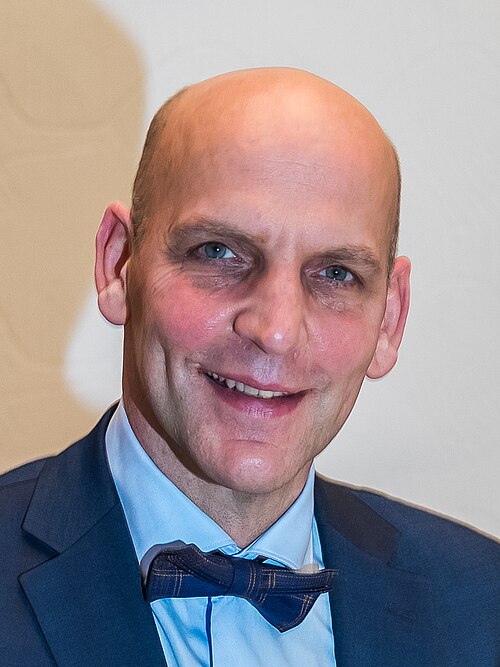
List (born 1968, Germany) was working at the Max-Planck-Institut für Kohlenforschung when, in 2000, he showed that the cheap amino acid L-proline could drive an asymmetric aldol reaction and favour one mirror image. He saw that a simple, metal-free organic molecule could be a general catalyst, and framed the idea as a new concept for chemistry.
MacMillan (born 1968, United Kingdom) had worked on metal catalysis but noticed that sensitive, costly metal catalysts were rarely used in industry. At Princeton and Berkeley he reasoned that a small organic molecule able to form an iminium ion could do the same job. In 2000 his imidazolidinone catalyst drove a reaction to over 90 per cent of one mirror image, and he coined the term organocatalysis.
Sources
Facts are pinned from the official Nobel Prize API. The explanations were written from these sources: