Click chemistry: snapping molecules together like a buckle
Awarded to Carolyn Bertozzi, Morten Meldal and K. Barry Sharpless “for the development of click chemistry and bioorthogonal chemistry”.
1Pick your depth
What was the 2022 Nobel Prize in Chemistry awarded for?
The 2022 Chemistry prize honours click chemistry: a way to build molecules by snapping two pieces together with a single fast, reliable reaction, the way a seatbelt buckle clicks shut. Morten Meldal and Barry Sharpless found the workhorse version, joining an azide and an alkyne with the help of copper. Carolyn Bertozzi then made the click run safely inside living cells, so scientists can tag a molecule in a living body without disturbing its chemistry.
2Guess first
Two molecules each carry a small chemical clip, an azide and an alkyne. Left alone they barely react. Add a pinch of copper and they join almost instantly. What is the copper doing?
How close were you?
CuAAC is fast and clean, yet you cannot use it to label molecules inside a living cell. Why not, and how did Bertozzi get around it?
How close were you?
3Learn it at ELI5
ELI5 done
Read the transcript
At 1:43 in the morning, a phone call woke Carolyn Bertozzi. She took a screenshot because she could not believe it. Building molecules is often slow and messy. Morten Meldal and Barry Sharpless found that a little copper makes 2 small pieces snap together, like a seatbelt buckle. But copper harms living cells. Carolyn used a piece bent into a tight ring, which clicks with no copper. Now glowing tags show where sugars sit on living cells. The three shared the 2022 Nobel Prize in Chemistry.
Undergrad done
Read the transcript
Morten Meldal's team ran a routine reaction in Denmark. Their alkyne reacted with an azide at the wrong end of its partner, forming a triazole ring. Copper ions had steered it toward one product. Meldal presented it in 2001 and published in 2002. That year, Barry Sharpless reported the copper reaction independently. He had coined click chemistry for building blocks that snap together quickly and efficiently. Copper is toxic to cells. Carolyn Bertozzi used a 1961 finding. An alkyne forced into a ring reacts with azides on its own. In 2004 she published this copper-free click. She later found sugars that seem to shield tumours from the immune system. Her team built a drug that breaks them down, now in clinical trials for advanced cancer.
Expert done
Read the transcript
In 2001, the year of his first Nobel Prize, Barry Sharpless urged chemists to stop imitating natural molecules. Scaling up the antibiotic meropenem, he noted, had taken 6 years of development. He proposed linking small blocks with complete carbon frames through nitrogen or oxygen bridges. Each link would use a reaction with a strong built-in drive. The crown jewel was published in 2002. Morten Meldal and, independently, Sharpless found that copper(I) catalyses the azide-alkyne cycloaddition. It runs up to 10 million times faster and gives essentially only the 1,4-disubstituted triazole. Copper(I), however, is cytotoxic. Carolyn Bertozzi had been labelling azide-bearing glycans on cells with a modified Staudinger reaction. In 2004 she replaced copper with ring strain, clicking those azides onto cyclooctynes. She had named the goal bioorthogonal chemistry in 2003. The handle must react with its partner and with nothing else in the cell.
Think of a seatbelt buckle. You bring the two ends together, push, and they snap shut with a click. They only fit each other, they hold tight, and you never have to wonder whether it worked.
Click chemistry does the same thing with molecules. Chemists put a small matching clip on each piece they want to join. When the two clips meet, they snap together fast and clean, almost always in the right place, and leave very little mess behind.
Snap, not glue
Most ways of building molecules are slow and fiddly, like gluing parts and hoping they hold. A click reaction is more like a buckle. It is fast, it is reliable, and it joins only the two pieces you meant to join.
Carolyn Bertozzi pushed the trick further. She built a version of the click that works inside a living cell without disturbing anything else in there. Now scientists can attach a tiny glowing tag to a sugar or a protein and watch where it travels while the cell keeps living as normal.
In 2001 Barry Sharpless and his colleagues proposed a new way to think about building molecules. Instead of long, custom syntheses, they argued chemists should rely on a small set of reactions that are fast, give high yields, work in mild conditions, and produce almost no unwanted byproducts. He called this approach click chemistry, because joining two pieces should be as simple and dependable as clicking a buckle.
The standout example is the reaction between an azide and an alkyne, two small chemical handles. On their own they react slowly and need heat. In 2002, Morten Meldal and Sharpless independently found that a copper catalyst transforms this reaction. With copper, the azide and alkyne snap together quickly at room temperature in water, forming a stable ring called a triazole and giving a single clean product.
Copper turns a sluggish reaction into a click
The copper-catalysed azide-alkyne cycloaddition, or CuAAC, became the most-used click reaction. It is selective, high-yielding, and tolerant of the many other groups present in a complex molecule. Today it is used to make pharmaceuticals, map DNA, and build tailored materials.
There was one place CuAAC could not go: inside living cells, because copper ions are toxic to them. Carolyn Bertozzi solved this. She found older work showing that an alkyne bent into a strained ring, a cyclooctyne, reacts with an azide on its own, no copper required. In 2004 she published this copper-free click and used it to track glycans, the sugar chains on the surface of cells.
Click chemistry is a design philosophy as much as a set of reactions. Sharpless, Kolb and Finn set out the criteria in 2001: a reaction should be wide in scope, give very high yields, generate only harmless byproducts, be stereospecific, and run under simple conditions, ideally in water and with easy product isolation. Reactions that meet this bar behave like modular couplings, letting chemists assemble large libraries of molecules from a few reliable building blocks.
Copper rewrites the Huisgen cycloaddition
The parent reaction is the Huisgen 1,3-dipolar cycloaddition of an azide and a terminal alkyne, which is slow and yields a mixture of 1,4- and 1,5-triazole regioisomers. Copper(I) changes the path: it forms a copper acetylide, accelerates the cycloaddition by many orders of magnitude, and delivers the 1,4-triazole as the sole product at room temperature and neutral pH. Meldal and Sharpless reported this independently in 2002.
Copper(I), though, generates reactive oxygen species and is cytotoxic, so CuAAC cannot run inside living cells. Bertozzi had already framed the goal she called bioorthogonal chemistry in 2003: a reaction whose partners are absent from biology and inert toward every functional group a cell contains, so it proceeds without perturbing native processes. Azides and alkynes fit, since neither appears in normal biochemistry.
The copper-free, strain-promoted click
Bertozzi revived a 1961 observation that an alkyne locked inside a strained eight-membered ring, a cyclooctyne, reacts with an azide without any catalyst. The distortion of the strained triple bond lowers the activation barrier, so the strain-promoted azide-alkyne cycloaddition, SPAAC, fires on its own. Published in 2004, it was an early bioorthogonal click and ran far faster than the Staudinger ligation it replaced.
What bioorthogonal click made possible
- Metabolic labelling: feed cells an azide-tagged sugar, let it incorporate into glycans, then attach a probe with a strain-promoted click to image where those sugars sit.
- Imaging in living animals: the copper-free click has been run in cultured cells, live zebrafish, and mice without harming them.
- Drug discovery and materials: CuAAC assembles candidate molecules, conjugates antibodies, and stitches together polymers and surfaces.
- Cancer research: these reactions are being investigated as ways to diagnose and treat cancer, for example by tagging tumour cells so they can be found and targeted.
The breadth of these uses is why the prize was shared three ways. Meldal and Sharpless supplied the reliable copper-catalysed coupling, Sharpless framed the click concept that gave it a purpose, and Bertozzi carried the chemistry across the line into living systems, where it now serves as a standard tool for watching biology at the molecular scale.
A chemical reaction that runs inside a living animal
Bertozzi's copper-free click is gentle enough to fire inside a living organism without harming it. Researchers have used it to label sugars on cells in cultured human cells, in live zebrafish, and in mice, watching specific molecules light up while the animal carries on as normal.
4Check yourself
What does click chemistry aim for in a reaction?
What role does copper(I) play in the classic CuAAC click reaction?
Why did Bertozzi develop a copper-free version of the click reaction?
Key terms
- Click chemistry
- An approach to making molecules by joining two pieces with a single fast, selective, high-yield reaction that works in mild conditions and leaves little waste.
- CuAAC
- The copper(I)-catalysed azide-alkyne cycloaddition, the most-used click reaction. Copper turns a slow azide-alkyne reaction into a fast one that gives a single triazole product.
- Triazole
- The stable five-membered ring formed when an azide and an alkyne click together. It is the durable link that holds the two joined pieces in place.
- Bioorthogonal chemistry
- A reaction that can run inside a living system without interfering with native biochemistry. The partners are absent from biology and do not react with the cell's own molecules.
- Cyclooctyne
- An alkyne forced into a strained eight-membered ring. The built-in strain lets it react with an azide on its own, replacing the toxic copper catalyst.
- Glycan
- A chain of sugars, often found coating the surface of cells. Bertozzi used bioorthogonal click reactions to tag and image glycans in living systems.
The laureates
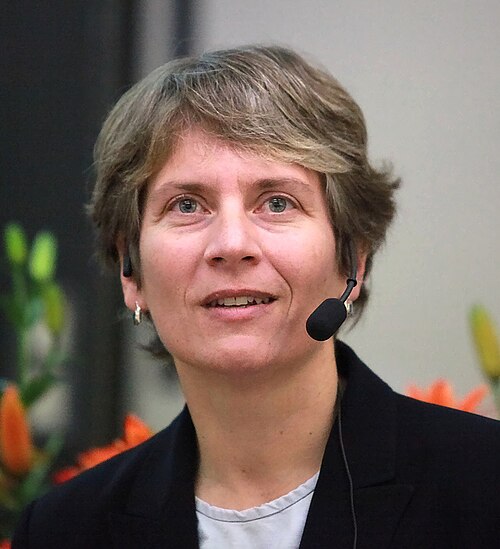
Carolyn R. Bertozzi (born 1966, USA) is a professor at Stanford University. In 2003 she coined the term bioorthogonal chemistry, and in 2004 she published a copper-free click reaction that runs safely inside living cells, which she used to track glycans, the sugar chains that coat cell surfaces.
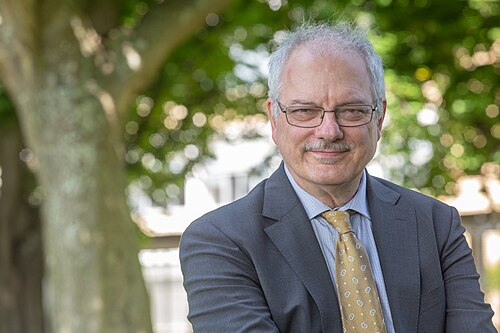
Morten Meldal (born 1954, Denmark) is a professor at the University of Copenhagen. Working at the Carlsberg Laboratory, he reported in 2002, independently of Sharpless, the copper-catalysed reaction that joins an azide and an alkyne into a triazole ring, the workhorse of click chemistry.
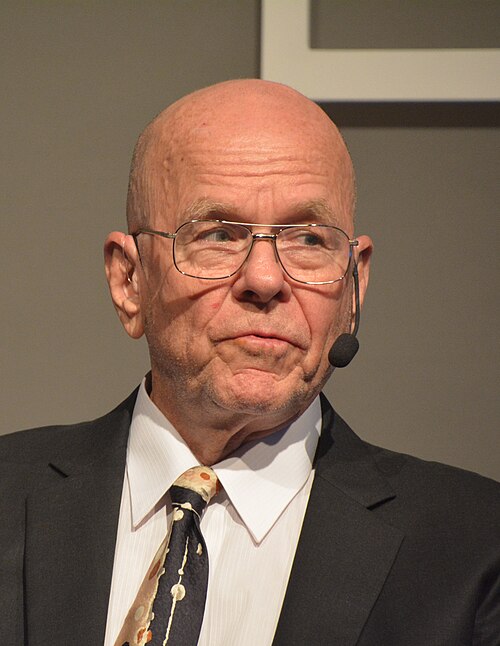
K. Barry Sharpless (born 1941, USA) works at Scripps Research in La Jolla, California. In 2001 he and his colleagues defined the idea of click chemistry, reactions that join building blocks quickly and cleanly, and in 2002 he reported the copper-catalysed azide-alkyne click independently of Meldal.
Sources
Facts are pinned from the official Nobel Prize API. The explanations were written from these sources: