Quantum dots: when size becomes colour
Awarded to Moungi Bawendi, Louis Brus and Aleksey Yekimov “for the discovery and synthesis of quantum dots”.
1Pick your depth
What was the 2023 Nobel Prize in Chemistry awarded for?
The 2023 Chemistry prize honours the quantum dot: a crystal so tiny that its size, not its chemistry, decides what colour it glows. Shrink a speck of one material and its light turns blue; grow the same speck and the light reddens. That single control now lights QLED televisions and helps surgeons see tumours.
2Guess first
You hold two specks of the exact same material. One glows blue, the other glows red. Their chemistry is identical. What is different about them?
How close were you?
A normal lump of a material has one fixed colour no matter how big the lump is. Why do these nanocrystals break that rule?
How close were you?
3Learn it at ELI5
ELI5 done
Read the transcript
Aleksey Yekimov heated melted glass, some batches for 1 hour and some for 4 whole days. Tiny crystals grew inside. The smaller they were, the bluer the light they soaked up. Crystals this small are quantum dots. Their size sets their colour. Louis Brus found the same in crystals floating in liquid. Early dots came in mixed sizes. Moungi Bawendi learned to make them nearly all one size. Now quantum dots turn blue light into red and green in some TV screens.
Undergrad done
Read the transcript
At Bell Labs, Louis Brus noticed that particles left on his lab bench now absorbed light differently. He guessed they had grown. He compared cadmium sulphide particles about 4.5 nanometres wide with ones of about 12.5. The smaller ones absorbed light shifted toward blue. Light lifts an electron across the band gap, leaving a hole. When the crystal is smaller than that pair's natural size, the gap widens. The dot then absorbs and glows bluer. In 1993, Moungi Bawendi's group at MIT grew dots of nearly uniform size. Such dots now help guide surgeons as they remove tumour tissue. Brus published in 1983. He did not know that Aleksey Yekimov had reported the effect in coloured glass 2 years earlier, in a Soviet journal.
Expert done
Read the transcript
In 1988, Moungi Bawendi joined Louis Brus's laboratory at Bell Labs as a postdoc. Their nanocrystals kept improving, yet they were still not good enough. Aleksey Yekimov in glass, and Brus in solution, had shown that smaller crystals absorb bluer light. Confinement energy grows with the inverse square of the radius. So any spread in size smears the spectrum. At MIT in 1993, Bawendi's group injected organometallic precursors into a hot coordinating solvent. Sudden supersaturation set off one burst of nucleation, and the temperature drop stopped further growth. After reheating, the nuclei grew slowly and in step. Samples drawn during one run gave a whole size series. The 1993 paper shows cadmium selenide crystals from about 1.2 to 11.5 nanometres. At room temperature, their luminescence reached a quantum yield of up to 10%. Earlier nanocrystals had managed only a few percent.
Think of a xylophone. The short bars ring out high notes and the long bars give low notes. Same wood, same material, but the size of the bar decides the pitch.
A quantum dot is a crystal so unbelievably small that it behaves the same way with light instead of sound. A tiny dot glows blue (a high note for light). A slightly bigger dot of the very same material glows green, then yellow, then red as it grows. You are not changing what it is made of. You are only changing how big it is.
Size is the dial
With quantum dots, a scientist can pick a colour the way you pick a note: by choosing the size of the crystal. That is what makes them so useful. You get a pure, tunable colour out of a single material just by controlling how small you make it.
This only works because the dots are nanometres wide, thousands of times thinner than a hair. At that size the strange rules of quantum physics take over, and size starts to behave like colour.
A quantum dot is a semiconductor nanocrystal, a grain of a material like cadmium selenide just a few nanometres across. To understand why its colour depends on size, follow one electron.
When light hits a semiconductor, it can kick an electron up across an energy step called the band gap. When the electron falls back down, the material releases a photon whose colour matches the size of that step: a big step means a high-energy blue photon, a small step means a low-energy red one. In an ordinary bulk crystal the band gap is fixed by the material, so the colour is fixed too.
Shrink the box, widen the gap
The excited electron and the hole it leaves behind form a pair with a natural size. If the crystal is smaller than that natural size, the pair is squeezed, and quantum mechanics responds by pushing the energy levels apart. The band gap grows. A smaller dot therefore has a bigger gap and emits bluer light. This squeezing effect is called quantum confinement.
Dot size sets the emitted colour
Same material throughout. Only the diameter changes. Smaller means a wider energy gap and bluer light.
The discovery came in two steps. In 1981 Aleksey Yekimov made the first deliberate quantum dots inside coloured glass, and in 1983 Louis Brus showed the same size-dependent effect in crystals floating in a solution. The problem was making them reliably. In 1993 Moungi Bawendi solved that with a method that produces dots of uniform size and clean optical quality, which is what finally made them practical.
Quantum confinement is the textbook particle-in-a-box made real. Confine a charge carrier to a region of size L and its kinetic energy is quantised in steps that scale as 1/L² (for an infinite well, Eₙ = n²h²/8mL²). As the nanocrystal radius r falls below the bulk exciton Bohr radius, this confinement term dominates and forces the effective band gap upward, blue-shifting both absorption onset and emission.
Why the gap scales as 1/r²
Brus modelled the lowest excited state of a spherical dot as E(r) ≈ E_bulk + (ħ²π² / 2r²)(1/m_e + 1/m_h) − 1.8 e² / (4πεε₀ r). The middle term is the kinetic confinement energy, positive and scaling as 1/r²; the last term is the electron-hole Coulomb attraction, scaling as 1/r. The 1/r² term wins as r shrinks, so smaller dots have larger gaps. Tune r and you tune the colour across the visible spectrum from a single composition.
Because emission energy depends so steeply on radius, the width of the emission line is set by the spread of sizes in the sample. A polydisperse batch emits a muddy, broad band; a monodisperse batch emits a clean, narrow colour. This is why synthesis, not just discovery, earned a share of the prize.
Separating nucleation from growth
Bawendi's 1993 method injects precursors into a hot coordinating solvent, triggering a single rapid burst of nucleation that is then quenched by the temperature drop. Nuclei subsequently grow slowly and in step, yielding nearly monodisperse nanocrystals. Capping the core with a higher-gap shell (for example CdSe/ZnS) passivates surface traps and lifts the fluorescence quantum yield, which is what production-grade dots require.
Where the tunable colour pays off
- Displays: quantum-dot films in QLED televisions convert blue backlight into pure, saturated reds and greens, widening the colour gamut.
- Biomedical imaging: bright, photostable dots tag and light up specific tissue, helping surgeons see the edge of a tumour.
- Solar cells and photocatalysis: size-tuned absorption lets dots harvest chosen slices of the spectrum or drive chemical reactions with light.
- The open problems: many high-performing dots contain cadmium, so heavy-metal-free alternatives such as InP are an active frontier, alongside reducing single-dot blinking.
A threefold size change spans the whole rainbow
A quantum dot that glows deep red is only about three times wider than one that glows blue, and both are just a few nanometres across, thousands of times thinner than a human hair. That barely-there difference in size is the entire reason for the change in colour.
4Check yourself
Two quantum dots are made of the identical material but glow different colours. What explains the difference?
As you make a quantum dot smaller, its glow shifts toward which colour?
Why did the synthesis of quantum dots, not just their discovery, earn a share of the prize?
Key terms
- Quantum dot
- A semiconductor crystal only a few nanometres across, small enough that quantum effects make its colour depend on its size.
- Quantum confinement
- The squeezing of an electron-hole pair when the crystal is smaller than the pair's natural size, which forces the energy levels apart and widens the band gap.
- Band gap
- The energy step an electron must cross in a semiconductor. The size of this step sets the colour of light the material absorbs and emits.
- Exciton
- The bound pair of an excited electron and the positively charged hole it leaves behind. Its natural size sets the scale at which confinement begins.
- Nanometre
- One billionth of a metre. Quantum dots are a few nanometres wide, thousands of times thinner than a human hair.
- Hot-injection synthesis
- Bawendi's method of injecting precursors into a hot solvent to trigger one quick burst of crystal formation, producing dots of uniform size.
The laureates

In 1993 Bawendi invented the hot-injection method, a way to grow quantum dots that are uniform in size and high in optical quality. It turned a delicate lab curiosity into a material you can manufacture, which is why quantum dots ended up in real products.
Working at Bell Labs in 1983, Brus was the first to show size-dependent quantum effects in particles floating freely in a solution. He demonstrated that the colour shift in tiny crystals was a genuine quantum phenomenon, not a chemical accident.
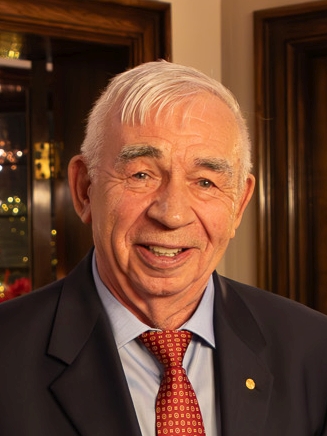
In 1981, working with coloured glass at the Vavilov State Optical Institute, Yekimov produced the first deliberate quantum dots and connected the glass's colour directly to the size of the crystals frozen inside it.
Sources
Facts are pinned from the official Nobel Prize API. The explanations were written from these sources: