Bank runs: how a rumour can topple a healthy bank
Awarded to Ben Bernanke, Douglas Diamond and Philip Dybvig “for research on banks and financial crises”.
1Pick your depth
What was the 2022 Nobel Prize in Economics awarded for?
The 2022 Economics prize honours the work that explained what banks really do and why they can fail so suddenly. Douglas Diamond and Philip Dybvig built a simple model showing that a bank funds long-term loans with deposits people can pull out at any moment, which is useful but leaves it open to a self-fulfilling panic. Ben Bernanke showed, using the Great Depression, that when banks collapse the damage spreads to the whole economy and turns a downturn into a catastrophe.
2Guess first
A bank has made good loans and is perfectly solvent. Not one loan has gone bad. Yet on Monday morning it collapses. What could have destroyed it overnight?
How close were you?
If a bank run can destroy even a healthy bank, why do rich countries almost never see them today?
How close were you?
3Learn it at ELI5
ELI5 done
Read the transcript
At Yale, 2 students waited outside their teacher's door. A kind helper gave them cookies. There, Douglas Diamond and Philip Dybvig talked a lot. Later, they explained why banks can suddenly fall. Banks lend your savings for years. If a rumour makes everyone grab their money, the rush empties the bank, even a healthy one. Their fix is a government promise to pay savers back, so nobody needs to rush. Ben Bernanke shared their 2022 prize. He showed that falling banks made hard times in the 1930s last longer.
Undergrad done
Read the transcript
Philip Dybvig's phone was on do not disturb. He woke to what looked like thousands of messages, and nobelprize.org showed his name beside Ben Bernanke and Douglas Diamond. Bernanke's 1983 paper studied the Great Depression, when the number of US banks halved in 3 years. With each failure, a bank's knowledge of its borrowers was lost, and credit dried up. In Diamond and Dybvig's model, deposits can leave on demand, while loans run for years. If savers expect a run, withdrawing first is rational, so the run fulfils itself. Their remedy, government deposit insurance, removes the reason to run. In theory, it never has to pay out. In the 2008 crisis, Bernanke led the Federal Reserve and put that research into policy.
Expert done
Read the transcript
In early March 1933, the US government closed every bank for a week to stop a panic. Industrial production had fallen 46 percent since January 1930. Ben Bernanke argued in 1983 that bank failures destroyed knowledge of borrowers, raising the cost of credit intermediation. In monthly data from 1921 to 1941, money shocks alone explained a modest part. Adding his failure proxies explained most of the drop. Douglas Diamond and Philip Dybvig modelled such runs. In their model, depositors privately learn if they must consume early. A demand deposit contract pools that risk, yet it admits a second Nash equilibrium where patient depositors run, expecting others to. Sequential service pays the first in line in full. With early demand uncertain, suspension is hard to time. Tax-funded deposit insurance stops the run before it starts. Bernanke's paper already cited their 1981 working paper.
Imagine a town where everyone keeps their savings at one bank. It does not leave that money sitting idle. It lends most of it to families buying homes and shops that want to grow, and those loans take years to pay back.
Here is the catch. You can take your money out whenever you want, but the bank's money is tied up in long loans it cannot call back quickly. If only a few people withdraw at a time, all is well. The danger is everyone trying to pull their money out at once.
Fear becomes the cause
If you hear a rumour that the bank is in trouble, the smart move is to grab your money before it runs out. But everyone thinking that way is what empties the bank. The panic makes itself come true, even if the bank was healthy.
The fix is simple. If the government promises your money back no matter what, you have no reason to rush, so the panic never starts. That promise is called deposit insurance, and it is one big reason bank runs are far rarer today.
Banks perform a trick economists call maturity transformation. Savers want their money to stay liquid, ready to withdraw on demand. Borrowers want the opposite: long loans they can repay slowly over years. A bank sits between the two, taking in short-term deposits and turning them into long-term loans. Diamond and Dybvig's 1983 paper showed that an institution shaped exactly like a bank is the efficient way to satisfy both sides at once.
This service is valuable, but it builds a fragility into the bank's very structure. Its assets, the loans, are illiquid and locked up for years, while its liabilities, the deposits, can be demanded back instantly. The bank never holds enough cash to pay everyone at the same moment. It does not need to, as long as withdrawals stay normal.
The run is a self-fulfilling prophecy
Diamond and Dybvig showed the model has two stable outcomes. In the good one, only depositors who genuinely need cash withdraw, and the bank works normally. In the bad one, depositors who fear a run rush to withdraw first, which drains the bank and forces it to dump loans at a loss. Because each depositor's best move depends on what the others do, the panic can be set off by rumour alone. The expectation of a run is what causes the run.
What turns a worry into a collapse
- A rumour spreads that the bank may not be able to pay everyone.
- Depositors know the bank serves people in order, first come first served, so latecomers may get nothing.
- Each saver races to withdraw before the cash runs out.
- The bank is forced to sell long-term loans early and at a loss, and it fails even though it was solvent.
Diamond and Dybvig also showed how to break the cycle. Government deposit insurance guarantees savers their money back, which removes any reason to join a run. In theory the guarantee is so effective that it rarely has to be paid out: knowing it exists is enough to keep everyone calm. This is why nearly every country now insures bank deposits, and it is a central part of modern bank regulation.
The Diamond-Dybvig model formalises maturity transformation as an insurance problem. Depositors face private, idiosyncratic liquidity shocks: some will need to consume early, some late, and none knows in advance which type they will be. A long investment pays well if held to maturity but little if interrupted. A bank offering a demand-deposit contract can pool this risk, paying early withdrawers more than the liquidation value of the asset and late withdrawers less than the full maturity return. Every depositor then gets better risk sharing than they could obtain by investing alone, which is the precise sense in which banks create liquidity.
Why one contract has both a calm state and a run state
The demand-deposit contract that delivers efficient risk sharing also admits a second Nash equilibrium. If a depositor expects everyone else to withdraw, the bank will be liquidated, so withdrawing now is the only way to recover anything. If she expects others to wait, waiting is best. Both expectations are self-confirming. The run equilibrium is driven by a shift in beliefs unconnected to the bank's fundamentals, so a solvent bank can be destroyed purely by a coordination failure among its own depositors.
First come, first served makes the race rational
What makes running individually rational is the sequential service constraint: the bank pays depositors in the order they arrive until its liquid resources are exhausted, so latecomers risk getting nothing. Suspending convertibility, freezing withdrawals once a threshold is hit, can halt a run, but Diamond and Dybvig showed it is not optimal when the true demand for cash is uncertain. Government-backed deposit insurance dominates it: by guaranteeing that the late withdrawer is made whole, it destroys the incentive to run in the first place and selects the good equilibrium.
Diamond and Dybvig explained why a single bank is fragile. Bernanke's 1983 paper, 'Nonmonetary Effects of the Financial Crisis in the Propagation of the Great Depression', showed why a wave of bank failures wrecks the whole economy. The dominant account at the time, from Friedman and Schwartz, was monetary: bank failures shrank the money supply. Bernanke argued that this channel alone was too small and too short-lived to explain a downturn that ran from 1929 to 1933 and lingered for years afterward.
Banks are hard-to-replace information machines
Bernanke's insight was that a bank is not just a holder of deposits but a low-cost credit intermediary that gathers costly knowledge about which local borrowers are creditworthy. When thousands of banks collapsed, that information capital was destroyed and could not be rebuilt quickly. The real cost of channelling savings to sound borrowers rose, credit to farms and firms became scarce, and output fell further. Using statistical analysis and historical records, Bernanke showed that bank failures had real, nonmonetary effects that turned a severe recession into the longest depression in modern history.
Together the three laureates laid the foundation of modern bank regulation. The same logic reaches well beyond traditional banks: in the early 2000s, lightly regulated shadow banks performed maturity transformation outside the regulated sector, and runs on them sat at the centre of the 2008 to 2009 crisis. Diamond and Dybvig's model still describes those runs, and Bernanke, by then chair of the US Federal Reserve, acted on his own research to keep credit flowing through it.
The economist who later had to use his own theory
Ben Bernanke spent the early 1980s proving that collapsing banks turned the slump of the 1930s into the Great Depression. In 2008, as chair of the US Federal Reserve, he faced almost exactly the crisis he had studied and used those lessons to keep credit flowing and stop a repeat. Few researchers ever get to apply their own findings on so large a stage.
4Check yourself
What does it mean to say a bank performs 'maturity transformation'?
In the Diamond-Dybvig model, why is a bank run described as self-fulfilling?
What did Bernanke's research show about the bank failures of the early 1930s?
Key terms
- Maturity transformation
- Funding long-term loans with short-term deposits. The bank borrows money that can be withdrawn at any moment and lends it out for years, bridging the gap between what savers and borrowers want.
- Bank run
- A situation where many depositors try to withdraw their money at the same time, usually because they fear the bank will run out of cash. The rush can drain and topple even a solvent bank.
- Self-fulfilling equilibrium
- An outcome that happens only because people expect it to. In a bank run, the belief that others will withdraw makes withdrawing rational for everyone, so the feared collapse actually occurs.
- Deposit insurance
- A government guarantee that depositors will get their money back even if the bank fails. Because savers no longer need to rush to withdraw, the guarantee prevents runs and rarely has to be paid out.
- Liquidity
- How easily an asset can be turned into spendable cash without losing value. Deposits are highly liquid; long-term loans are not.
- Credit intermediation
- The work banks do to channel savings to borrowers, including judging who is creditworthy. Bernanke showed that when banks fail this service is lost, making credit scarce and costly.
The laureates
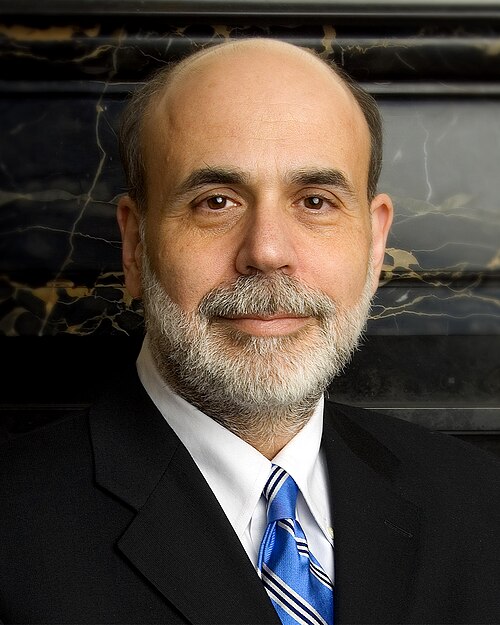
Bernanke's 1983 study of the Great Depression used statistics and historical records to show that the wave of bank failures in the early 1930s was not merely a symptom of the slump but a cause of it. When banks collapsed, the knowledge they held about local borrowers was lost, credit dried up, and a sharp recession became a decade-long depression. Born 1953 in the USA.

With Philip Dybvig, Diamond built the 1983 model that explained why banks exist, why they are fragile, and how deposit insurance protects them. In a 1984 paper he also showed how banks serve society as delegated monitors, checking that borrowers honour their loans. Born 1953 in the USA.
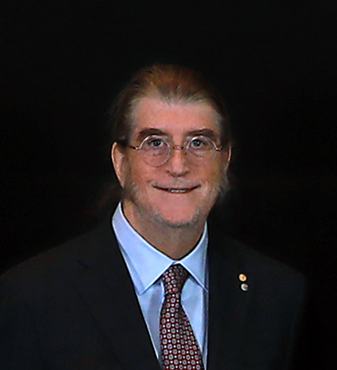
With Douglas Diamond, Dybvig co-authored the 1983 paper 'Bank Runs, Deposit Insurance, and Liquidity', which showed how a bank run can be a self-fulfilling panic that destroys even a solvent bank, and how a government guarantee can stop it. Born 1955 in the USA.
Sources
Facts are pinned from the official Nobel Prize API. The explanations were written from these sources: