Why the gender pay gap opens with the first child
Awarded to Claudia Goldin “for having advanced our understanding of women’s labour market outcomes”.
1Pick your depth
What was the 2023 Nobel Prize in Economics awarded for?
The 2023 Economics prize honours Claudia Goldin for explaining two hundred years of women and work. By rebuilding US data that had quietly undercounted women, she showed that female participation in paid work traced a U-shape rather than a steady climb, and that today's pay gap opens not at hiring but after the first child, driven by jobs that overpay long, inflexible hours.
2Guess first
Across two hundred years, as the United States grew steadily richer, did the share of women in paid work simply rise the whole time?
How close were you?
A man and a woman leave the same school, take the same job, and start on the same salary. A few years later he clearly earns more. What changed?
How close were you?
3Learn it at ELI5
ELI5 done
Read the transcript
One morning in October 2023, a phone call woke Claudia Goldin. She had won the Nobel economics prize. She asked her husband to take the dog out and make some tea. For years, Claudia counted how many American women worked for pay, going back 200 years. Old records often missed women's work. Long ago, many women worked on family farms. When factories came, fewer married women had paid jobs. Later, office and shop jobs brought them back. On a chart, the line dips and climbs back, like the letter U.
Undergrad done
Read the transcript
As a child, Claudia Goldin wanted to be a detective. In high school she read about microbe hunters, and dreamed of detective work under a microscope. Instead she became an economic historian, trawling archives for over 200 years of US data on women and work. One clue was expectations. Many young women in the 1950s had housewife mothers, so they did not plan on long careers. From the end of the 1960s, young women could get the contraceptive pill. US states allowed it in different years. With Lawrence Katz, Goldin used that timing. The pill let women delay marriage and children, and more of them trained for law and medicine. In 2023 she became the first woman to win the economics prize on her own.
Expert done
Read the transcript
Old US census records often listed a married woman's occupation simply as wife. Many such women worked beside their husbands on farms or in family businesses. Claudia Goldin's corrected rate for married women at the end of the 1890s was almost 3 times the census figure. Today, she showed, most of the gender earnings gap lies within occupations, and it largely opens with the first child. With Marianne Bertrand and Lawrence Katz, she followed Chicago Booth MBAs from the classes of 1990 to 2006. An 11 log point gap at graduation widened to 60 log points after 10 years. The penalties for time out are nonlinear. Goldin calls jobs that pay more per hour for long, inflexible hours greedy work. Pharmacy is her counterexample. Pharmacists are highly substitutable, so pay is linear in hours. Among pharmacists with children, hours worked explain the gap completely.
Imagine lining up every working-age woman in America over the last two hundred years and asking, decade by decade, how many were doing paid work. You might guess the number just kept rising as the country got richer. It did not.
It dipped first. On farms, women worked all day. When factories took over, married women were pushed out of paid jobs, so the number fell. Later, as offices, shops, schools and hospitals grew, women came back. Drawn out on a chart, the trend looks like the letter U.
A pay gap that starts with a baby
Today a man and a woman can leave the same school, take the same job, and earn the same pay. The gap between them mostly opens after their first child, because someone has to cut back to flexible hours, and that someone is usually the mother.
Goldin's real gift was the digging. She rebuilt two centuries of records that had quietly logged farmers' wives and home weavers as having no job at all, and only then could the true picture appear.
Claudia Goldin is an economic historian. To study women and work she did something unglamorous and decisive: she went into 200 years of US archives and rebuilt the data, because older records often logged a farmer's wife or a home weaver as having no occupation.
With cleaner numbers a clear shape appeared. Female labour-force participation did not climb steadily with economic growth. It traced a U. In the early 1800s, as the economy moved from farms to factories, married women's participation fell, held down by social norms and a labour market rebuilt around male industrial jobs. From the early 1900s, as clerical and service work expanded and schooling spread, women returned. Growth on its own, Goldin showed, does not draw women into paid work; the kind of work and the norms around it decide.
The power of the pill
In the late 1960s the contraceptive pill gave young women direct control over the timing of children. Because US states granted young women access in different years, Goldin and Lawrence Katz could compare otherwise similar groups. Women with early access delayed marriage and childbirth, invested in long professional training, and entered law, medicine and business in far larger numbers.
Yet a gap remained. In rich countries women are now often more educated than men and equal-pay laws exist, but women still earn roughly 10 to 20 percent less. Goldin, with Marianne Bertrand and Lawrence Katz, traced where this gap comes from. At graduation, pay is nearly equal. It is parenthood that bends the two paths apart: after the first child, mothers' earnings drop and then grow more slowly, even when the mother and father hold the same degree and the same job.
Goldin's contribution is empirical and historical rather than theoretical. Her raw material is more than 200 years of US data on women's earnings and employment, much of it reconstructed from sources that systematically undercounted female labour. Correcting that measurement error was itself a result: a large share of married women's work in the agrarian and early industrial economy had simply gone unrecorded.
Why growth did not lift women into work
Plotting corrected participation against time, Goldin found a U spanning the period from the late eighteenth century. Married women's participation declined through early industrialisation, as production left the home and norms cast paid work as incompatible with marriage, then rose through the twentieth century with the service sector and rising education. Because output per head grew throughout, the U breaks any simple one-directional link between development and female employment.
For the modern rise she identified a specific lever. In 'The Power of the Pill' (2002), Goldin and Lawrence Katz used the staggered timing of US state laws granting young, unmarried women access to oral contraception as a natural experiment. Cohorts with early access delayed marriage and first birth and invested in professional degrees, which helps explain the surge of women into law, medicine and business from the 1970s onward.
Where the gap actually opens
Goldin, Bertrand and Katz (2010), studying Chicago MBA graduates, showed that male and female earnings start almost equal and then diverge sharply after the first child. The mother's hours fall and her pay grows more slowly, even at the same education and occupation. Across high-income countries the residual gap of 10 to 20 percent is now explained largely by this motherhood effect rather than by hiring discrimination or differences in schooling.
The mechanism she named is greedy work. Many high-paying jobs pay disproportionately more for long, continuous, on-call hours, so two parents cannot each hold one without sacrificing the care of their children. The household specialises: one parent, usually the father, takes the greedy job, while the other, usually the mother, takes flexible, lower-paid work. The gap, in this account, is less a matter of men versus women than a tax on whoever supplies the flexibility.
“If we want to eradicate or even narrow the pay gap, we must first plunge deeper toward the root of these setbacks and give the problem a more accurate name: greedy work.”Claudia Goldin, Career and Family (2021)
What the prize established
- Female labour-force participation follows a U over 200 years, so economic growth alone does not draw women into paid work.
- Much of women's historical work was unrecorded, and correcting the data changed the picture of the past.
- The contraceptive pill, identified through a natural experiment, accelerated women's entry into long professional careers.
- The modern gender earnings gap opens after the first child, not at hiring, and persists across the same degrees and occupations.
- Pay structures that reward long, inflexible hours, what Goldin calls greedy work, convert that childcare asymmetry into a durable pay gap.
The pay gap is mostly a parenthood gap
In high-income countries women now often hold more education than men, and equal-pay laws are on the books, yet women earn roughly 10 to 20 percent less. Goldin showed that men and women with the same degree and the same job start out paid almost the same. The gap opens only after the first child, so parenthood, not the hiring desk, explains most of what remains.
4Check yourself
Over 200 years, what shape did women's US labour-force participation trace?
According to Goldin, when does most of today's gender earnings gap open?
What does Goldin mean by 'greedy work'?
Key terms
- U-shaped participation curve
- Goldin's finding that the share of US women in paid work fell during nineteenth-century industrialisation and rose again in the twentieth century, rather than climbing steadily with economic growth.
- Gender earnings gap
- The difference between what men and women earn on average. In high-income countries it now runs roughly 10 to 20 percent, even where women are as educated as men.
- The parenthood effect
- The pattern, documented by Goldin and co-authors, in which men's and women's earnings start nearly equal and diverge after the first child, even at the same education and occupation.
- Greedy work
- Jobs that pay disproportionately more for long, continuous, on-call hours. Because flexibility is sacrificed by whoever handles childcare, usually the mother, this pay structure widens the gender gap.
- Natural experiment
- A study design that uses real-world variation, such as US states granting young women access to the contraceptive pill in different years, to compare otherwise similar groups as if they had been assigned by chance.
The laureate
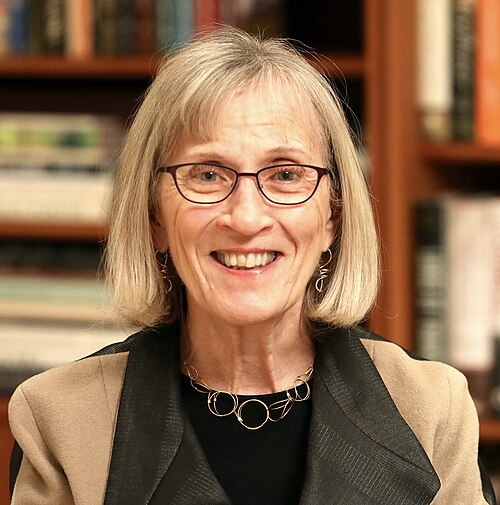
Born in New York in 1946, Goldin is an economic historian and labour economist at Harvard University. She spent years in the archives reconstructing more than 200 years of US data on women's work, much of which older records had hidden or miscounted. In 2023 she became the first woman to win the economics prize on her own.
Sources
Facts are pinned from the official Nobel Prize API. The explanations were written from these sources: