Abdulrazak Gurnah: the refugee's crossing between worlds
Awarded to Abdulrazak Gurnah “for his uncompromising and compassionate penetration of the effects of colonialism and the fate of the refugee in the gulf between cultures and continents”.
1Pick your depth
What was the 2021 Nobel Prize in Literature awarded for?
The 2021 Literature prize went to Abdulrazak Gurnah, a novelist born on the island of Zanzibar who fled to England as an eighteen-year-old refugee after the 1964 revolution. Across ten novels written in English, his second language, he traces what European colonialism did to East Africa and what exile does to the people it scatters, telling those histories from the side of the displaced rather than the empire.
2Guess first
The Nobel citation honours Gurnah for writing about colonialism and refugees. You might expect such fiction to be told from the side of the powerful: the empires and the host countries. Whose viewpoint do you think Gurnah deliberately chose instead?
How close were you?
3Learn it at ELI5
ELI5 done
Read the transcript
On the island of Zanzibar, a boy named Abdulrazak read so late into the night that his father came and told him to switch off the light. When he was 18, people like his family were in danger. He had to flee to England, leaving his family behind. In England he felt homesick and poor. At 21, he began to write. His books are about people who leave home, and about what happens when faraway countries rule a land. In 2021, Abdulrazak Gurnah won the Nobel Prize in Literature.
Undergrad done
Read the transcript
On 7 October 2021, Mats Malm of the Swedish Academy rang Abdulrazak Gurnah. Gurnah thought it was a prank. He went to watch the announcement on his computer. He grew up on Zanzibar, which left British rule in December 1963. A revolution followed, and citizens of Arab origin like him were persecuted. At 18 he fled to England. Swahili was his first language, yet at 21, in exile, he began writing in English. His breakthrough novel, Paradise, from 1994, retells the Quran's story of Joseph during the colonisation of East Africa. Its hero, Yusuf, feels forced to leave Amina, the woman he loves, and join the German army he had despised. In his Nobel lecture, Gurnah said that writing has always been a pleasure.
Expert done
Read the transcript
In 1984, Abdulrazak Gurnah could at last return to Zanzibar, which he had fled at 18. He saw his father shortly before his father died. His fiction is written from exile about the place he left, so memory is vital to it. Yet he avoids nostalgia for a pristine, pre-colonial Africa. Desertion, from 2005, contradicts what he calls the imperial romance. An Englishman, Martin Pearce, collapses in the street and falls in love with Rehana, the daughter of the merchant who helps him. In Gurnah, the tale continues on African soil. In Admiring Silence and By the Sea, silence becomes the refugee's shield against racism and prejudice. In By the Sea, Saleh seeks asylum in England on a visa forged in the name of a bitter enemy. The Academy finds it characteristic of Gurnah to frustrate the reader's expectation of a happy ending.
Abdulrazak Gurnah is a novelist who was born on the island of Zanzibar, off the coast of East Africa. When he was eighteen, a violent revolution forced him to leave his home, and he arrived in England in 1968 as a refugee. He had to build a new life in a country that often did not want him.
Years later, out of homesickness, he began writing stories in English about people like himself: people who had left one place and never quite arrived in another. He writes about what European empires did to East Africa, and about how it feels to be a stranger far from where you were born. Over ten novels that work made him one of the great writers of leaving home, and in 2021 it won him the Nobel Prize in Literature.
He was almost forty before his first novel
Gurnah spent years as a university teacher before he published fiction. His first novel, Memory of Departure, came out in 1987, when he was nearly forty. He had begun writing in his twenties, in English, to make sense of the home he had lost.
Gurnah was born in 1948 in the Sultanate of Zanzibar, into a family of Yemeni Arab descent. In 1964 a revolution overthrew the island's Arab elite, thousands of people were killed, and Gurnah fled, reaching England in 1968. He settled into a long career as a literary scholar at the University of Kent, where he is now an emeritus professor of English and postcolonial literatures. His fiction grew out of that exile. As the Swedish Academy put it, the disruption of the refugee runs throughout his work.
What set him apart was the angle he wrote from. East Africa had long been described by Europeans, from the outside. Gurnah deliberately upends that colonial perspective and writes from the side of the people the empires acted upon. He recovers a Swahili coast that had its own trade, faith, and languages long before the colonisers arrived.
Paradise (1994)
Paradise is set in East Africa in the early twentieth century, as German colonial power tightens its grip. A boy named Yusuf is pawned by his father to a merchant to settle a debt, then travels with trading caravans deep into the interior. The novel reworks the Quranic and biblical story of Joseph and shows a complex African world on the eve of being swallowed by empire. It was shortlisted for both the Booker and the Whitbread prizes and made Gurnah's name.
The ground he returns to
- The effects of colonialism, especially German and then British rule on the East African coast.
- The refugee and displacement: leaving home, and arriving as an unwanted stranger.
- Memory and identity, written from exile to hold on to a place left behind.
- Silence as a survival strategy, a way to shield the self from prejudice and from the past.
In novels such as Admiring Silence (1996) and By the Sea (2001), silence becomes the refugee's defence. A narrator hides his Zanzibar past from his English family and invents a more convenient life story, a deception that slowly corrodes him. His 2020 novel Afterlives returns to the world of Paradise, following East Africans caught up as soldiers in Germany's colonial wars, and traces the damage across several generations.
Gurnah belongs to a foundational generation of postcolonial writers who reached Britain from the edges of the empire, alongside figures such as Sam Selvon, George Lamming, and the young V. S. Naipaul. He arrived in the late 1960s, at the height of anti-immigrant feeling, the years of Enoch Powell's notorious speeches. That hostility is woven through his fiction, where characters who cross the world for safety or study still meet the old racist invective in the streets of London.
His method is patient and oblique. He writes in English, his second language after Kiswahili, and consciously breaks with the colonial novel by refusing its outside gaze. Memory is the engine of the work: his stories are told from exile but reach back constantly to the coast he left. He uses recurring devices, among them the changing of characters' names, to show identities being remade by migration, war, and the demands of strangers.
Known to scholars before he was known to the public
For most of his life Gurnah was read more by students of postcolonial literature than by the general public, and several of his ten novels were out of print when the prize was announced. The 2021 award was widely seen as the Academy reaching past the bestseller lists to honour a body of work about colonialism and migration that had been built quietly over more than thirty years.
The choice carried weight beyond literary craft. Gurnah was the first Black writer to win the prize since Toni Morrison in 1993, and the award landed in the middle of fierce European arguments about refugees and borders. By insisting on the inner life and dignity of the displaced, his fiction offers a direct counter to the political language that reduces them to a problem at the gate.
Why this prize mattered
- It centred the refugee not as a statistic but as a person with a past, a memory, and a name.
- It told East African history from the inside, breaking with the colonial point of view.
- It honoured a writer working in his second language, far from the commercial mainstream.
- It arrived during Europe's refugee debates, giving the displaced a human face rather than a headline.
“What you don't know in those situations is what it is that you're giving up, that you're leaving behind. So going to England was like an adventure in some ways, but it was also a great loss.”Abdulrazak Gurnah, recalling his 1968 arrival in England
He wrote in his second language
Kiswahili was Gurnah's first language, and as a young man in Zanzibar he had almost no access to literature written in it. He began writing in English in his early twenties, in exile, and built an entire Nobel-winning body of work in a language he came to as an adult.
4Check yourself
Why did Gurnah leave Zanzibar for England?
What does the Nobel citation say Gurnah's work penetrates?
In novels like By the Sea, what role does silence often play for Gurnah's refugee characters?
Key terms
- Postcolonial literature
- Writing that examines the experience and aftermath of European colonial rule, often from the point of view of the colonised. Gurnah is both an emeritus professor of it and a leading practitioner.
- Zanzibar Revolution
- The 1964 overthrow of Zanzibar's ruling Arab elite, in which thousands of people were killed. It forced Gurnah and many others to flee the island.
- Swahili coast
- The East African coastline and islands, including Zanzibar, with a long history of Indian Ocean trade, Islam, and the Kiswahili language. It is the lost homeland at the centre of Gurnah's fiction.
- Refugee
- A person forced to leave their country to escape danger. The fate of the refugee, named directly in Gurnah's citation, is his central subject.
- Kiswahili (Swahili)
- Gurnah's first language. He had little access to literature written in it as a young man and chose to write his novels in English, his second language.
The laureate
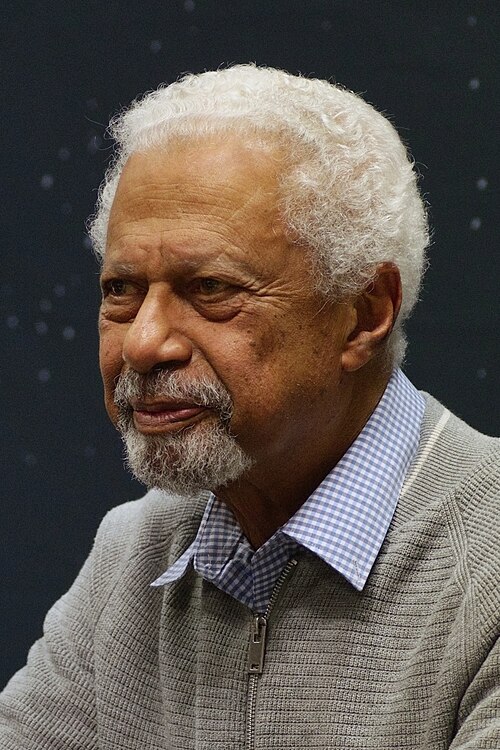
Born in 1948 in the Sultanate of Zanzibar, into a family of Yemeni Arab descent, Gurnah fled the island at eighteen after the 1964 revolution and reached England in 1968 as a refugee. He became an emeritus professor of English and postcolonial literatures at the University of Kent and writes his fiction in English, his second language after Kiswahili.
Sources
Facts are pinned from the official Nobel Prize API. The explanations were written from these sources: