Annie Ernaux: turning one private life into social evidence
Awarded to Annie Ernaux “for the courage and clinical acuity with which she uncovers the roots, estrangements and collective restraints of personal memory”.
1Pick your depth
What was the 2022 Nobel Prize in Literature awarded for?
The 2022 Literature prize went to the French writer Annie Ernaux, the first Frenchwoman to win it. She built almost her entire body of work out of her own life, written in a cool, factual style, so that one ordinary biography becomes a window onto a whole social class, a generation, and a century.
2Guess first
A memoir is usually the most personal kind of writing, full of I and private feeling. Ernaux does almost the opposite: she writes about her own life in a cool, factual, sometimes third-person voice. Why drain the personality out of the most personal material?
How close were you?
3Learn it at ELI5
ELI5 done
Read the transcript
Annie grew up in a small town in Normandy, where her parents ran a café and grocery. Between customers, her mother read novels, and she liked Annie reading more than sewing. She became the writer Annie Ernaux. Most of her books are about her own life, told in plain words. One short book is about her father, a hard-working man with little schooling. The Swedish Academy says it gives him back his dignity. In 2022, she became the first French woman to win the Nobel Prize in Literature.
Undergrad done
Read the transcript
As a literature student, Annie Ernaux wrote a promise in her diary. She would write to avenge her people, labourers and shopkeepers despised for their accent and lack of education. Later, married with 2 children and a teaching job, she moved further from writing each day. Her father's death and her working-class students led her back to her own people. She broke with the beautiful sentences she taught in class. With A Man's Place, her portrait of her father, she began writing flat, without metaphors or signs of emotion. The violence now came from the facts themselves. On 6 October 2022, she was alone in her kitchen, listening to the radio to hear who had won the Nobel Prize in Literature. It was her.
Expert done
Read the transcript
One Sunday in June, in the early afternoon, Annie Ernaux's father tried to kill her mother. Her book La honte, or Shame, opens on that moment. Ernaux describes herself as an ethnologist of herself. Nobel Committee chair Anders Olsson notes how deeply the sociologist Pierre Bourdieu impressed her. Her breakthrough came with La place in 1983, barely 100 pages on her father and the milieu that formed him. There she argues for écriture plate, a plain writing that shows his world and his language. In Les années, from 2008, the third person of collective memory replaces the spontaneous memory of the self. The poet Durs Grünbein called it a sociological epic. To the Nobel Prize Museum, she gave a small alarm clock. She had it for 20 years, notably while writing Les années, her longest book.
Annie Ernaux is a French writer, born in 1940, who won the Nobel Prize in Literature in 2022. She is the first French woman ever to win it. Almost everything she wrote is about her own life: her parents, her childhood in a small Normandy town, her schooling, her love affairs, and an illegal abortion she had as a young woman.
But she does not write to show off her feelings. She writes in a plain, almost factual style, as if she were a reporter describing her own life from the outside. The surprise is that by looking so honestly at one ordinary life, hers, she shows you something much bigger: how a whole social class lived, what people were ashamed of, and how the world changed across the twentieth century.
She grew up behind a shop counter
Her parents ran a cafe and grocery in Normandy. Ernaux studied her way into the middle class and became a teacher, which left her caught between two worlds. That gap is the engine of nearly all her books.
Ernaux's debut, Les armoires vides (Cleaned Out, 1974), and her next two books were autobiographical novels. Then she broke away from fiction. Her breakthrough, La place (A Man's Place, 1983), is a short, unsentimental portrait of her father and the working-class world that shaped him. From then on she wrote what she calls auto-socio-biography: she starts from her own life but treats it as a specimen, evidence of how class, gender, and history act on an ordinary person.
Flat writing (ecriture plate)
Ernaux rejects lyrical, beautiful prose as a kind of class privilege, a language her parents never had access to. Instead she writes in what she calls flat or neutral writing, drawn from the plain idiom of the letters she once exchanged with her family. As she put it, she is not trying to make it beautiful, she is trying to make it right.
The life she keeps returning to
- Her father and his social world, in A Man's Place (1983).
- Her mother and her decline, in A Woman's Story (1987).
- Shame, and the experience of being a class defector, someone who climbs out of the class they were born into.
- Her illegal 1963 abortion, in Happening (2000), later adapted into a film that won the Golden Lion at Venice.
- Sexuality and desire, treated with the same clinical honesty, in Simple Passion.
Her most ambitious book is Les annees (The Years, 2008), often called the first collective autobiography. Instead of saying I, she writes about herself in the third person and the collective we, moving through six decades of French life from the 1940s onward. The private memory of one woman becomes the shared memory of a whole generation.
Ernaux's project is best understood against the sociology she read as a young teacher. Pierre Bourdieu and Jean-Claude Passeron's Reproduction (1970) argued that schooling does not dissolve class but quietly reproduces it, exerting a symbolic violence that makes domination feel natural. Ernaux lived exactly that as she passed from a grocer's daughter into the educated middle class, and her writing turns the felt experience of that passage into literature. She named the result auto-socio-biography (autosociobiography), and the term has since hardened into a recognised genre.
“I could not write other than in a clinical way, observing what I do and experience as if it were done and experienced by someone else.”Annie Ernaux
The stylistic correlate is ecriture plate. For Ernaux, lyricism would beautify and therefore betray the world of her parents, so she strips it away. Anders Olsson, chair of the Nobel literature committee, described her work as uncompromising and written in plain language, scraped clean. This is not coldness but a discipline: restraint becomes a way of granting dignity to lives that French literature, written largely by and for the bourgeoisie, had rarely taken seriously. From the start she described her aim as to avenge her people, to give literary weight to a world that had carried almost none in books.
In The Years she pushed the method furthest, narrating her own life entirely in the third person and the collective we, with no Proustian rush of private remembrance to carry her back. The German poet Durs Grunbein called it a sociological epic. The book reads photographs, songs, advertisements, and political slogans as the shared furniture of memory, so that a single life becomes a way of remembering an entire postwar society.
Her win was both celebrated and contested. Ernaux is a committed leftist and feminist who has signed petitions and backed boycotts, and some readers found her politics, or her frank treatment of sex and the body, provocative. Others argued that her books sat closer to sociology or memoir than to literature. The Academy's answer was that the personal, handled with this much courage and clinical acuity, is precisely where the collective becomes visible. Her influence is now plain: writers such as Didier Eribon and Edouard Louis extend her account of the class defector, and a younger readership, shaped by the fourth wave of feminism, has made her one of the most studied living French authors.
An autobiography with no I
The Years tells the story of Ernaux's own life from the 1940s to the 2000s without ever once writing the word I. She uses she and we instead, so a personal memoir becomes the collective memory of a generation. Critics have called it the first collective autobiography.
4Check yourself
What is Annie Ernaux best known for in her writing?
What does Ernaux mean by treating her life as auto-socio-biography?
Why was her 2022 Nobel Prize historically notable for France?
Key terms
- Auto-socio-biography
- A term coined by Ernaux (also written autosociobiography) for writing that starts from the author's own life but treats it as social evidence, placing the private self inside its class, history, and collective memory.
- Ecriture plate
- Flat or neutral writing. Ernaux's pared-down, factual style, drawn from the plain language of letters home, which refuses lyricism as a form of class privilege.
- Class defector
- From the French transfuge de classe: someone who moves out of the social class they were born into, usually through education. Ernaux's passage from a grocer's daughter to a teacher is central to her work.
- The Years (Les annees)
- Ernaux's 2008 book, often called the first collective autobiography, narrating her life from the 1940s onward in the third person and the collective we.
- Symbolic violence
- A term from the sociologist Pierre Bourdieu for the quiet way institutions like schools make class domination feel natural. Ernaux read Bourdieu and turned that idea into literature.
The laureate
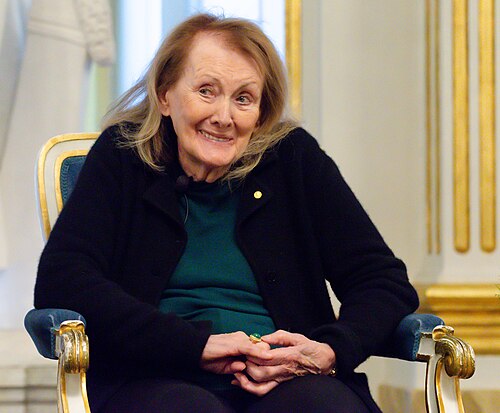
Born in 1940 in Lillebonne, Normandy, and raised in the small town of Yvetot where her parents ran a cafe and grocery, Ernaux is a French novelist and former literature teacher. She studied her way out of the working class, and that passage between two worlds runs through nearly all her books. She is the first French woman to receive the Nobel Prize in Literature.
Sources
Facts are pinned from the official Nobel Prize API. The explanations were written from these sources: