Han Kang: the fragile body under the weight of history
Awarded to Han Kang “for her intense poetic prose that confronts historical traumas and exposes the fragility of human life”.
1Pick your depth
What was the 2024 Nobel Prize in Literature awarded for?
The 2024 Literature prize went to the South Korean writer Han Kang for spare, poetic prose that looks directly at historical atrocity, from the 1980 Gwangju massacre to the 1948 killings on Jeju Island, and at the fragility of the human body and life itself. She is the first Korean and the first Asian woman to win the literature prize.
2Guess first
Most novels about a massacre reach for scale: huge casts, vivid action, clear villains. Han Kang often does the opposite, writing quiet, poetic sentences about a single body, a dead boy, a woman who will not eat. How can that restraint carry the weight of real historical violence?
How close were you?
3Learn it at ELI5
ELI5 done
Read the transcript
One afternoon, an 8-year-old girl in Korea got caught in a sudden downpour. She waited under a roof with other children, while another crowd waited across the street. She understood that each of them felt the rain, just like she did. That girl became the writer Han Kang. Her books let you feel what others feel. Some tell true, sad events from Korea's past, when many people lost their lives. She tells them gently. In 2024, she became the first Korean to win the Nobel Prize in Literature.
Undergrad done
Read the transcript
Packing to move, Han Kang opened an old shoe box of childhood diaries. Inside was a thin booklet she had stapled together in 1979, called A Book of Poems. In one poem, the 8-year-old asked where love lives. Inside her beating chest, she answered. Love, she wrote, is a gold thread between our hearts. She published her first poems in 1993, then turned to fiction, which won her the 2024 Nobel Prize in Literature. In The Vegetarian, a woman named Yeong-hye stops eating meat to refuse violence, and comes to believe she is turning into a plant. Deborah Smith's translation won the Man Booker International Prize in 2016. She set the final scene in an ambulance, because she hoped Yeong-hye would stay alive.
Expert done
Read the transcript
At 12, Han Kang found the Gwangju Photo Book, made in secret by survivors and families of the dead. It showed residents killed by the military in 1980, and a long queue waiting to give blood. For Human Acts, she read more than 900 testimonies. After a young teacher's last diary entry, she asked whether the dead can save the living. In the novel, souls of the dead leave their bodies to witness what was done to them. The Korean title, Sonyeon-i onda, means the boy comes, in the present tense. We Do Not Part, from 2021, turns to the Jeju killings of the late 1940s. In its last part, two friends light a candle at the bottom of the sea. The Swedish Academy calls Han Kang an innovator in contemporary prose, aware of the links between body and soul, the living and the dead.
Han Kang is a South Korean writer of novels and poems. In 2024 she became the first Korean, and the first Asian woman, to win the Nobel Prize in Literature.
Her books are quiet, but they hit hard. She writes in short, careful, poetic sentences about painful things: a woman who suddenly refuses to eat meat, or real massacres from Korea's past in which ordinary people were killed. She does not look away from suffering, and she does not shout about it either. She writes about it gently, which somehow makes it land even harder.
The Vegetarian won the Booker
Her novel The Vegetarian won the International Booker Prize in 2016, the first Korean-language novel ever to do so. That win introduced readers around the world to her work, years before the Nobel.
Han Kang was born in 1970 in Gwangju and moved to Seoul as a child. She comes from a literary family and began as a poet in 1993 before turning to fiction. That training shows: critics describe her prose as lyrical and compressed, closer to poetry than to ordinary storytelling, even when the subject is brutal.
The Vegetarian (2007)
Told in three parts, the novel follows Yeong-hye, an ordinary woman in Seoul who stops eating meat after a violent nightmare and slowly comes to believe she is turning into a plant. Her refusal to live by the body's normal rules provokes disgust, control, and violence from the people around her. Translated by Deborah Smith, it won the 2016 International Booker Prize, the first Korean-language novel to do so.
The threads that run through her work
- The body as a battleground: hunger, illness, desire, and the will to refuse, most visible in The Vegetarian.
- Historical trauma: state violence against ordinary people, told from the side of the victims.
- Grief and the dead, who in her books are never fully gone and sometimes speak.
- A spare, poetic style that works through silence and image rather than melodrama.
Human Acts (2014)
Human Acts centers on the 1980 Gwangju uprising, in her own home city, where the South Korean military killed hundreds of students and unarmed civilians. Built around the death of a boy named Dong-ho, the novel moves across survivors and decades, and at moments lets the souls of the dead step out of their bodies to witness what was done to them. It reaches toward what is sometimes called witness literature.
Her later novel We Do Not Part (2021) turns to another buried atrocity, the killings on Jeju Island in 1948 and 1949. Across these books a single project comes into view: using the most delicate language possible to hold the heaviest history. Winning the Nobel made her the first Korean and first Asian woman to receive the literature prize, and put Korean literature, long carried abroad by a handful of translators, at the center of world attention.
Han Kang's work sits at the meeting point of two Korean histories that the state long preferred to forget. Human Acts (2014) returns to the Gwangju uprising of May 1980, when the military crushed a pro-democracy protest in her home city and killed hundreds of students and unarmed civilians. We Do Not Part (2021) reaches back further, to the mass killings on Jeju Island in 1948 and 1949. By telling these events from inside the bodies and memories of ordinary people, rather than as official history, she places herself in the lineage of witness literature while refusing its usual documentary tone.
What makes her distinctive is the gap between subject and style. The Swedish Academy praised her intense poetic prose, and critics note how she renders atrocity in language that stays lyrical, restrained, and close to the senses. In Human Acts she lets the souls of the dead detach from their bodies and watch their own destruction, a device that turns reportage into something closer to elegy. The recurring claim across her books is that the body itself, hungry, wounded, or refusing, is where history leaves its deepest marks.
Her preoccupation with the body predates the historical novels. An early work, Your Cold Hands (2002), centers on a sculptor obsessed with casting women's bodies in plaster, probing what the body shows and what it hides. The Vegetarian (2007) pushes that question to an extreme through Yeong-hye, whose decision to stop eating meat and to imagine herself as a plant reads at once as breakdown, protest, and a longing to leave the violence of being human. The White Book (2016), by contrast, turns inward to private grief, built around an older sister who died only hours after birth.
The Vegetarian and its translation
Han Kang's global rise is inseparable from translation, and from a debate about it. Deborah Smith's English version won the 2016 International Booker, but after the win Korean critics and the writer Tim Parks argued it embellished and at times mistranslated the original. Smith replied in the Los Angeles Review of Books that no translation is ever purely literal, and Han Kang, who reads English, has stood by the work while agreeing to correct errors in later editions. The episode became a landmark case in how world literature gets made, and who gets the credit.
Why the 2024 prize mattered
- It was the first Nobel Prize in Literature for a South Korean writer, and the first for an Asian woman.
- It honoured literature that confronts state violence directly, naming events some governments preferred to bury.
- It highlighted how much Korean writing reaches the world through a small number of translators, and how fragile that bridge is.
- It rewarded restraint and poetic compression at a moment when much acclaimed fiction runs long and loud.
She let the dead watch their own bodies
In Human Acts, her novel about the 1980 Gwangju massacre, Han Kang does something startling: she lets the souls of the murdered detach from their corpses and witness their own annihilation. It is how she gives voice to victims the official record tried to erase, and a clear example of her poetic prose turning unbearable history into something a reader can hold.
4Check yourself
How did Han Kang make Nobel history in 2024?
What links her novels Human Acts and We Do Not Part?
In The Vegetarian, what does the main character Yeong-hye come to believe about herself?
Key terms
- Gwangju uprising
- A 1980 pro-democracy uprising in the South Korean city of Gwangju, Han Kang's birthplace, where the military killed hundreds of students and civilians. It is the historical core of Human Acts.
- Jeju killings
- A period of state violence on South Korea's Jeju Island in 1948 and 1949 in which many civilians were killed. It is the historical subject of We Do Not Part.
- Witness literature
- Writing that bears testimony to historical atrocity, often from the side of the victims. Han Kang's Human Acts is placed in this tradition, though her poetic style departs from its usual documentary tone.
- International Booker Prize
- A major award for fiction translated into English, splitting the prize between author and translator. The Vegetarian won it in 2016, the first Korean-language novel to do so.
- Poetic prose
- Fiction written with the compression, rhythm, and imagery of poetry. The Nobel citation praises Han Kang's intense poetic prose.
The laureate
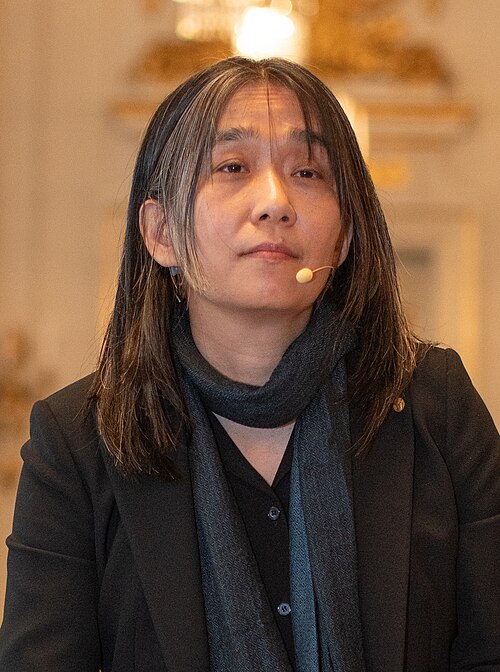
Born in 1970 in Gwangju, South Korea, Han Kang moved to Seoul as a child and comes from a literary family; her father is a respected novelist. A poet who turned to fiction, she is the first Korean and the first Asian woman to win the Nobel Prize in Literature.
Sources
Facts are pinned from the official Nobel Prize API. The explanations were written from these sources: