Catching the hidden virus in the blood supply
Awarded to Harvey J. Alter, Michael Houghton and Charles M. Rice “for the discovery of Hepatitis C virus”.
1Pick your depth
What was the 2020 Nobel Prize in Medicine awarded for?
The 2020 Medicine prize honours the detective work that unmasked the hepatitis C virus, the hidden cause of a liver disease people were catching from blood transfusions. Three scientists proved that a single unknown virus was to blame and then read out its genetic code. Their work made it possible to screen blood and to cure an infection that used to last a lifetime.
2Guess first
Doctors in the 1970s kept seeing patients catch hepatitis from blood transfusions, but tests for the two known hepatitis viruses, A and B, came back negative. What was going on?
How close were you?
The virus's genes had been copied and a blood test already existed. Why did scientists still not feel sure that this one virus, on its own, caused the disease?
How close were you?
3Learn it at ELI5
ELI5 done
Read the transcript
Before 5 in the morning, Harvey Alter's phone rang. He did not answer. When it rang a third time, he got up crossly and heard he had won a Nobel Prize. Long before, some people got sick livers after receiving blood from others. Harvey showed that an unknown germ in that blood caused it. Michael Houghton searched for years and found the germ's genes. It was a new virus, hepatitis C. Charles Rice proved that this virus alone could cause the illness. Today, medicines can cure hepatitis C.
Undergrad done
Read the transcript
In the 1980s, Michael Houghton drove to work past new hotels going up near his lab. He later joked that about 10 were built before his team found what it was hunting. The target caused non-A, non-B hepatitis. At the National Institutes of Health, Harvey Alter found that many transfusion patients still got hepatitis despite hepatitis B screening. Their blood passed the disease to chimpanzees. Houghton's team cloned DNA fragments from an infected chimpanzee's blood. Screening them with patients' antibodies turned up one clone from a new virus, hepatitis C. Charles Rice built a working copy of the virus's RNA. Injected into chimpanzee livers, it caused hepatitis on its own. Sensitive blood tests have since essentially eliminated post-transfusion hepatitis in many parts of the world.
Expert done
Read the transcript
At about 4:30 in the morning, Charles Rice's phone rang. He guessed one of his minus 80 freezers was warming up. When it rang again, the Nobel secretariat was on the line. The story began with Harvey Alter's transfusion studies at the National Institutes of Health. With hepatitis A and B excluded, a transmissible agent remained, and it passed to chimpanzees. Michael Houghton's team at Chiron built a library of cloned fragments from infected chimpanzee blood. Screening it with patient sera yielded one positive clone. Published in 1989, it came from a new flavivirus, hepatitis C. In St. Louis, Rice engineered a genome with a newly defined region at its end and without inactivating variants. Reported in 1997, this RNA, injected into chimpanzee livers, produced virus and disease. That day, Houghton warned that hepatitis C still kills around 400,000 people every year.
Picture doctors in the 1970s with a mystery on their hands. Some patients who received a blood transfusion came down with hepatitis, a liver illness, weeks later. Doctors could test for the two hepatitis viruses they knew about, called A and B. The tests kept coming back negative. So what was making people sick?
It turned out a third, hidden virus was riding along in the blood. Catching it took detective work by three scientists. First they showed the cause really was a new virus. Then they pulled the virus's genes out of infected blood and gave it a name, hepatitis C. Finally they proved that this one virus, all by itself, was enough to cause the disease.
From hidden to curable
Once scientists could name the virus, they could test donated blood for it and keep it out of transfusions. Later they built pills that clear the virus from the body. A disease that used to be a lifelong threat can now be cured.
By the 1960s and 1970s, two viruses were known to cause hepatitis. Hepatitis A spreads through contaminated food and water and causes a short illness. Hepatitis B spreads through blood and can become chronic, and once a blood test for it existed, infected donations could be screened out. Yet many people still caught hepatitis after a transfusion, and tests for both known viruses were negative.
A new virus, defined
At the US National Institutes of Health, Harvey Alter showed that most of this transfusion hepatitis was caused by neither A nor B. Crucially, blood from these patients could transmit the illness to chimpanzees, the only susceptible animal besides humans, and the agent behaved like a virus. The mystery disease got a placeholder name: non-A, non-B hepatitis.
Cloning the culprit
The virus was too scarce to catch under a microscope, so Michael Houghton's team at the Chiron Corporation took an untested route. They built a library of DNA copies from the nucleic acid in infected blood, then screened those clones with antibodies taken from patients. A clone whose protein the patient antibodies recognised had to come from the virus. That fragment led to the full genome, and the virus was named hepatitis C.
Risk of chronic hepatitis after surgery or many transfusions
Before any blood screening existed, versus after donated blood is screened for the hepatitis viruses.
One question still hung in the air. Finding the virus's genes in sick patients was a powerful clue, but it did not prove that this virus, on its own, caused the disease. That final proof came from Charles Rice.
The case for hepatitis C was built the way causation in infectious disease usually is, by steadily ruling out alternatives and then meeting the bar of Koch's postulates at the molecular level. Each laureate supplied one link, and only the three together amount to proof.
A transmissible, virus-like agent
Alter's transfusion studies established that the residual post-transfusion hepatitis was a distinct clinical entity, not a variant of A or B. By transmitting disease to chimpanzees with patient plasma, and by showing the agent shared the physical properties of a virus, he converted an epidemiological puzzle into a defined, transmissible viral disease. The chimpanzee model he helped establish was the platform everything later depended on.
Immunoscreening a blind cDNA library
With no culture system and no visible particle, Houghton's group at Chiron extracted total nucleic acid from the plasma of an infected chimpanzee, copied it into DNA, cloned it into a bacterial expression vector, and screened the resulting clones with serum from non-A, non-B patients. A single reactive clone encoded a protein recognised only by antibodies from infected people. It traced to an RNA genome of roughly 9,600 nucleotides found only in infected samples. The agent was a positive-sense single-stranded RNA virus of the Flaviviridae family, named hepatitis C virus, and the same proteins became the basis of an antibody blood test.
A functional full-length clone
Cloning showed the virus was present, not that it alone caused disease. Rice, drawing on his work with related flaviviruses, noticed that published HCV sequences lacked a conserved region at the end of the genome needed to start replication, and that lab isolates carried scattered mutations that would inactivate the virus. He engineered a complete RNA that restored the missing element and removed the disabling mutations, a consensus functional clone. Injected directly into the liver of chimpanzees, this RNA alone produced replicating virus, a specific antibody response, and the liver pathology of human disease. That closed the loop: hepatitis C virus by itself causes hepatitis C.
What the discovery delivered
- Blood screening: donated blood is now tested for the virus, which made transfusion-acquired hepatitis C rare.
- Direct-acting antivirals: pills that block specific viral enzymes now cure most infections in a matter of weeks.
- Research tools: Rice's replication-competent clones, and the cell-culture systems that followed, let scientists dissect the full viral life cycle.
- Open problems: there is still no vaccine, and many infected people remain undiagnosed, so the World Health Organization treats hepatitis C as an elimination target rather than a solved problem.
“The discovery of Hepatitis C virus revealed the cause of the remaining cases of chronic hepatitis and made possible blood tests and new medicines that have saved millions of lives.”Nobel Assembly at Karolinska Institutet, 2020 prize announcement
From mystery to cure in a single career
When Alter began his work, catching hepatitis from a transfusion was a real danger, with no test and no cure. Within a few decades the same virus could be screened out of the blood supply and cleared from the body with a short course of pills. Few diseases have travelled from unknown to curable so quickly.
4Check yourself
What did Harvey Alter prove about the mystery hepatitis spreading through blood transfusions?
How did Michael Houghton's team find the virus when standard methods had failed?
Why was Charles Rice's experiment the final piece of proof?
Key terms
- Hepatitis
- Inflammation of the liver. It can cause fatigue, nausea and jaundice, and over years can scar the liver (cirrhosis) or lead to liver cancer.
- Non-A, non-B hepatitis
- The placeholder name given to transfusion-linked hepatitis that tested negative for both the hepatitis A and hepatitis B viruses. It was later shown to be caused by hepatitis C virus.
- Hepatitis C virus (HCV)
- A small, enveloped, positive-sense single-stranded RNA virus of the Flaviviridae family. Its genome is about 9,600 letters long and it infects liver cells.
- cDNA library
- A collection of DNA copies made from the genetic material in a sample. Screening such a library let Houghton's team pull out a fragment belonging to the unknown virus.
- Functional clone
- A laboratory-built, complete and working copy of a virus's genome. Rice's functional clone of HCV could replicate and cause disease, which is what proved the virus was the cause.
- Direct-acting antivirals
- Drugs that block specific steps in the hepatitis C virus life cycle. A short course of these pills now cures most infections.
The laureates

Alter, born in the United States in 1935, led transfusion-medicine research at the National Institutes of Health in Bethesda. In the 1970s he proved that most hepatitis caught from blood transfusions was caused by neither hepatitis A nor hepatitis B. By showing the disease could pass to chimpanzees, he established that an unknown virus was responsible and defined the new illness as non-A, non-B hepatitis.
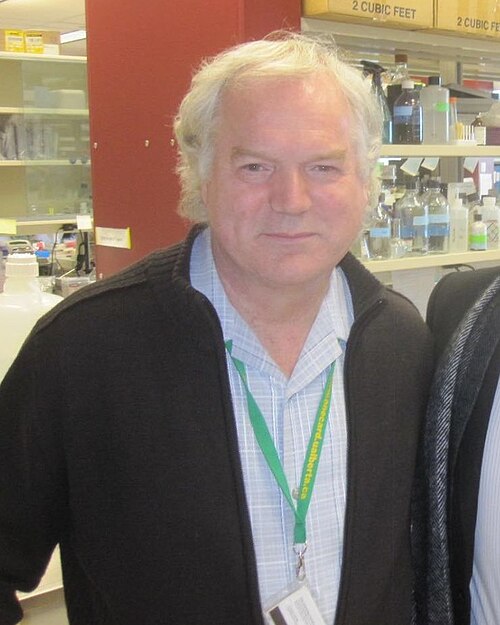
Houghton, born in the United Kingdom in 1949 and now at the University of Alberta in Canada, isolated the virus's genes while at the Chiron Corporation. Rather than catch the virus under a microscope, his team cloned genetic fragments from infected blood and used antibodies from patients to fish out a piece of the unknown agent. They named it hepatitis C virus and turned the find into a blood test.

Rice, born in the United States in 1952 and now at Rockefeller University in New York, supplied the final proof through work begun at Washington University in St. Louis. He spotted a missing tail in the viral genome and disabling mutations in lab samples, then engineered a clean, complete RNA copy. Injected on its own into the liver, it caused hepatitis, showing that hepatitis C virus alone was the cause.
Sources
Facts are pinned from the official Nobel Prize API. The explanations were written from these sources: