How your body turns heat and a touch into a nerve signal
Awarded to David Julius and Ardem Patapoutian “for their discoveries of receptors for temperature and touch”.
1Pick your depth
What was the 2021 Nobel Prize in Medicine awarded for?
The 2021 Medicine prize honours the discovery of the tiny channels in your nerve endings that sense temperature and touch. David Julius used capsaicin, the burn of chili, to find TRPV1, a channel that opens when things get painfully hot. Ardem Patapoutian poked cells until he found Piezo, the channel that turns physical pressure into the feeling of touch.
2Guess first
A drop of chili extract and a mug of hot water both make your skin feel like it is burning. Nothing is actually warm about the chili. What do the chili and the real heat have in common inside your nerve?
How close were you?
Touch has no special chemical to trigger it, only a physical push. So how could a scientist hunt down the single molecule responsible for feeling a poke?
How close were you?
3Learn it at ELI5
ELI5 done
Read the transcript
Ardem Patapoutian's phone was on do not disturb. So the Nobel caller found his 92-year-old dad, who rang him. Chili peppers make your mouth burn. David Julius found the tiny gate in our nerves that chili and painful heat both open. Ardem poked cells and switched off their genes one by one, until the cells stopped feeling the poke. He found a pressure gate called Piezo. Open gates send signals to your brain, so you feel heat and touch. They shared the 2021 Nobel Prize in Physiology or Medicine.
Undergrad done
Read the transcript
On 4 October 2021, David Julius woke to a text from his sister-in-law. A Thomas Perlmann was trying to reach him, and he seemed like a reasonable guy. In the late 1990s, Julius turned to capsaicin, the burning compound in chili. His team screened millions of DNA fragments from sensory neurons, and one gene made unresponsive cells react. It encoded TRPV1, an ion channel opened by painful heat. Julius and Ardem Patapoutian each used menthol to find TRPM8, a cold sensor. Patapoutian's team poked cells and silenced genes one by one. Losing one gene left the cells numb to the poke. They named its channel Piezo1, after the Greek word for pressure. This knowledge now helps develop treatments, including for chronic pain.
Expert done
Read the transcript
As a student in Beirut, Ardem Patapoutian was held for a day by militants. They threatened to shoot his knee to see if he could feel pain. If he could not, they said, he was a spy. Months later he left for Los Angeles. Years on, at Scripps, he went looking for the channels that sense mechanical force. Postdoc Bertrand Coste poked Neuro2A cells while recording their currents, knocking candidate genes down with RNA interference. The 72nd candidate wiped out the currents. Adding its protein, Piezo1, to embryonic kidney cells made them respond to force. David Julius had reached heat by another route. His group expressed a sensory neuron DNA library in cells that ignore capsaicin, and cloned TRPV1, a channel gated by painful heat. Piezo2 proved essential for touch and key to proprioception. People born without it struggle to learn to walk.
Close your eyes and someone hands you a warm mug. You feel the heat. Press a finger on the table and you feel the push. But how does your skin actually turn 'hot' or 'a touch' into something your brain can read?
The answer is tiny gates called ion channels, sitting in the endings of your nerves. A gate stays shut until the right signal arrives. When it opens, charged particles rush through, and that little jolt makes the nerve fire off a message to your brain.
Two gates, two senses
David Julius found the gate for heat by using capsaicin, the chemical that makes chili peppers burn. Ardem Patapoutian found the gate for touch by poking cells with a tiny needle until he spotted the one that answered back.
So the burn of a chili and the warmth of a mug pull the same trick on your body: both open the heat gate. And a poke, a hug, or the floor under your feet all open the touch gate. Same idea, two different doors.
Your sense of temperature and touch is called somatosensation. For decades scientists knew the skin could report heat, cold, and pressure, but not which molecules did the reporting. The 2021 prize went to the people who found them.
David Julius started with a clever probe: capsaicin, the compound that makes chili peppers feel hot. He built a library of genes switched on in sensory neurons and dropped them, one batch at a time, into cultured cells that normally ignore capsaicin. After a long search, a single gene made those cells respond. It coded for a brand-new ion channel, later named TRPV1.
A channel that reads painful heat
TRPV1 does not only answer to capsaicin. It also opens when the temperature climbs above about 43 °C, the point where heat starts to hurt. That single result explained how a change in temperature becomes an electrical signal: heat opens the channel, positive ions flow in, and the nerve fires.
The same trick uncovered cold. Working separately, Julius and Patapoutian both used menthol, the cooling compound in mint, to find TRPM8, a related channel switched on by cold.
Touch was harder, because the trigger is a physical push, not a chemical. Patapoutian's team found a line of cells that gave off a tiny electrical blip when poked with a micropipette. They lined up 72 candidate genes and switched them off one at a time. When one particular gene was silenced, the poking went unfelt. They had found a mechanically gated channel and named it Piezo1, from the Greek word for pressure; a close relative turned out to be Piezo2.
The touch and balance channel
Piezo2 turned out to be the main channel for the sense of touch. It also reports proprioception, your sense of where your limbs are without looking. Later work tied Piezo channels to blood pressure, breathing, and bladder control as well.
TRPV1 is a nonselective cation channel and the prototype of a polymodal sensor: it funnels several painful inputs onto one pore. Heat above roughly 43 °C, protons from acidic tissue, capsaicin, and certain endogenous lipids all converge to open it. Capsaicin binds a pocket in the channel's transmembrane region, and the open channel passes Na+ and, importantly, Ca2+. The resulting depolarisation of the free nerve ending drives action potentials along nociceptive fibres toward the spinal cord.
One pore, many keys
What makes TRPV1 a landmark is that a chemical ligand (capsaicin) and a physical stimulus (heat) gate the same channel, and their effects combine: warmth lowers the temperature threshold, so capsaicin makes already-warm skin feel scalding. Knockout mice lacking the capsaicin receptor (Caterina et al., 2000) showed impaired responses to heat and to capsaicin, proving the channel is required rather than merely correlated with the sensation.
The methodological lesson is expression cloning with a functional readout. Julius did not purify a protein; he used capsaicin sensitivity as a selectable phenotype and let the cells report which cDNA conferred it. That logic generalised by swapping the probe: menthol revealed the cold channel TRPM8, and a mechanical poke revealed Piezo. The pattern is reusable: pick a stimulus you can apply at the bench, build a cellular readout that answers it, and the responsible gene falls out. Decades of physiology had described these sensations in detail without a single molecule attached to them, so the prize rewards turning each feeling into a named, testable protein with a known pore and a known trigger.
Force read from the membrane
Piezo1 and Piezo2 are large homotrimers shaped like a three-bladed propeller that bows the membrane into a curved nano-dome (about 28 nm across in Piezo2). Tension in the surrounding membrane flattens the dome, and that shape change opens a central cation pore. Because the channel reads force carried by the lipid bilayer, poking, stretching, or shear can all gate it. Coste et al. (2010) showed Piezo1 and Piezo2 are the essential components of distinct mechanically activated currents.
What these channels do beyond the lab bench
- Piezo2 is the principal channel for light touch and for proprioception; people who lack working PIEZO2 have profound deficits in touch and coordination.
- TRP and Piezo channels feed many reflexes: TRPV1 in inflammatory pain and body-temperature control, Piezo channels in vascular tone, breathing, and bladder control.
- Because TRPV1 sits at the start of several pain pathways, it is an actively pursued analgesic target; high-dose capsaicin patches already exploit the channel's desensitisation.
- Open questions include the precise gating transitions, the partner proteins that tune mechanosensitivity in living tissue, and how each channel is shut off once the stimulus passes.
Your chili dinner is a lie your nerves believe
A chili pepper is not hot in temperature at all, yet it can make your mouth feel like it is on fire. Capsaicin works by jamming open TRPV1, the exact channel that genuine heat above 43 °C uses. Your nerves cannot tell the chemical from real warmth, so the brain receives the same burning alarm either way.
4Check yourself
Why did David Julius use capsaicin, the burning compound in chili peppers, in his search?
What kind of stimulus opens the Piezo channels?
TRPV1 is described as 'polymodal'. What does that mean here?
Key terms
- TRPV1
- An ion channel in heat-sensing nerve endings. It opens in response to capsaicin, acid, and temperatures above about 43 °C, letting positive ions in to start a heat or pain signal.
- Capsaicin
- The pungent compound that makes chili peppers feel hot. Julius used it as a probe to identify the heat-sensing channel TRPV1.
- Ion channel
- A protein pore in a cell membrane that opens to let charged ions pass. When ions flow through a sensory channel, the nerve cell's voltage changes and it fires a signal.
- TRPM8
- A cold-sensing channel related to TRPV1, identified using menthol. It explains why mint and low temperatures both feel cool.
- Piezo channels
- Mechanically gated ion channels (Piezo1 and Piezo2) that open when the cell membrane is pushed or stretched. Piezo2 is the main channel for touch and body position.
- Mechanically gated channel
- A channel opened by physical force rather than a chemical or a voltage. Force in the surrounding membrane changes the channel's shape and opens its pore.
- Proprioception
- The sense of where your limbs are and how they move without looking at them. Piezo2 is essential for it.
The laureates
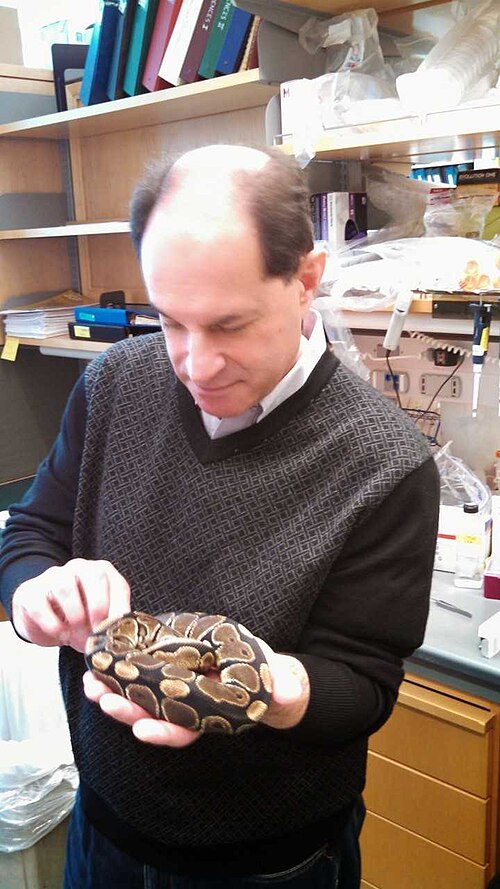
Julius used capsaicin, the compound that makes chili peppers burn, as a probe to fish out the gene for a heat sensor. In 1997 his lab identified TRPV1, the first heat-activated ion channel, which explained how a change in temperature becomes an electrical signal in the body. Born 1955.
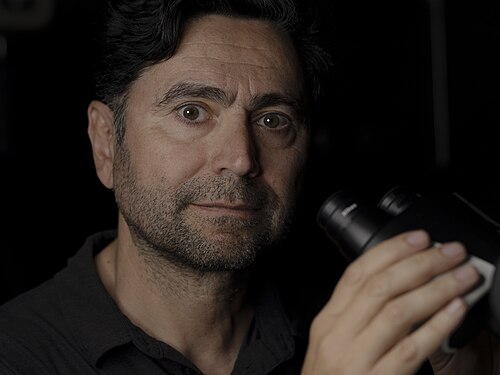
Patapoutian found cells that gave off a tiny electrical signal when poked with a fine needle, then switched off candidate genes one at a time until he found the channel responsible. That work, published in 2010, identified Piezo1 and Piezo2, the channels that turn mechanical force into touch and a sense of body position. Born 1967.
Sources
Facts are pinned from the official Nobel Prize API. The explanations were written from these sources:
- Press release: The Nobel Prize in Physiology or Medicine 2021 (NobelPrize.org)
- The Nobel Prize in Physiology or Medicine 2021, official summary (NobelPrize.org)
- TRPV1 (Wikipedia)
- PIEZO2 (Wikipedia)
- Caterina et al., The capsaicin receptor: a heat-activated ion channel in the pain pathway, Nature 1997 (Julius Lab, UCSF)