The base swap that let mRNA become a vaccine
Awarded to Katalin Karikó and Drew Weissman “for their discoveries concerning nucleoside base modifications that enabled the development of effective mRNA vaccines against COVID-19”.
1Pick your depth
What was the 2023 Nobel Prize in Medicine awarded for?
The 2023 Medicine prize honours the small chemical change that made mRNA vaccines possible. Synthetic mRNA put into the body sets off an immune alarm and is destroyed before it can work. Karikó and Weissman found that swapping one of its building blocks, uridine, for a close cousin lets the mRNA slip past the alarm, get read into protein, and safely train the immune system.
2Guess first
You inject lab-made mRNA carrying instructions to build a harmless piece of a virus. Instead of quietly making that protein, the body raises an alarm and destroys the mRNA almost immediately. What is the body reacting to?
How close were you?
Natural mRNA inside your own cells does not set off this alarm, even though it is also RNA. What is different about it that the lab-made version is missing?
How close were you?
3Learn it at ELI5
ELI5 done
Read the transcript
In 1997, Katalin Karikó and Drew Weissman met at a copy machine in a university hallway. They got talking. Your cells read tiny instruction notes called mRNA. Each note says what to build. Scientists wanted lab-made notes to teach the body to fight germs. But the body treated those notes as intruders and destroyed them. Katalin and Drew swapped one of the note's 4 letters for a near twin. The alarm went quiet, and cells read the notes. In 2020, that swap helped make COVID-19 vaccines in record time.
Undergrad done
Read the transcript
Katalin Karikó says the University of Pennsylvania forced her to retire. In 2013 she joined BioNTech in Germany, still feeding cells by hand at 58. In December 2020, two COVID-19 vaccines built on modified mRNA won approval. The idea behind that modification came from her work with Drew Weissman. Lab-made mRNA alarmed dendritic cells, while mammalian RNA, rich in modified bases, did not. In 2005, the pair added modified bases to lab-made mRNA, and the inflammation almost vanished. Papers in 2008 and 2010 found a second gain. Modified mRNA calmed an enzyme that brakes protein production, so cells made far more protein. Weissman says they both sleep badly, so they often traded ideas by email between 3 and 5 in the morning.
Expert done
Read the transcript
In 2005, Drew Weissman and Katalin Karikó exposed dendritic cells to RNA from different sources. Bacterial RNA and lab-made mRNA set off strong cytokine release. Mammalian RNA, rich in modified nucleosides, stayed quiet. Toll-like receptors in endosomes sense that foreign RNA. Swapping in nucleosides such as pseudouridine or 2-thiouridine let mRNA largely escape the sensing. The modifications work like a badge of self. Unmodified mRNA also activates PKR, which phosphorylates eIF2 alpha and stalls translation. The laureates' 2008 and 2010 papers showed that pseudouridine dampens PKR, so protein output rises. Later work moved to N1-methylpseudouridine, which raised expression further. Both mRNA vaccines approved in late 2020 use it, with the SARS-CoV-2 spike message carried in lipid nanoparticles. In phase 3 trials after 2 doses, the Pfizer-BioNTech vaccine showed 95% efficacy, and Moderna's showed 94%.
Your cells are tiny factories. To build a protein they follow a set of instructions carried on a molecule called mRNA. Think of mRNA as a recipe card the factory reads.
Scientists wanted to write their own recipe cards, slip them into the body, and have our own cells build something useful, like a harmless piece of a virus that trains our defences. But there was a catch. When they made mRNA in the lab and put it into cells, the body treated it as an intruder, sounded an alarm, and destroyed the card before it could be read.
Swap one letter and the alarm goes quiet
mRNA is spelled with four letters. Karikó and Weissman swapped one of them, U, for a near twin called pseudouridine. With that tiny change the body stopped raising the alarm, the recipe got read, and the cell built the protein.
That one swap is what finally turned mRNA into medicine, and it is the reason the COVID-19 mRNA vaccines work.
An mRNA is a message. It is written in four bases, A, U, G and C, and a cell's ribosomes read it to build a specific protein. The dream was to make mRNA in the lab, deliver it, and have the body manufacture a chosen protein on demand, the same way it makes its own proteins every day.
The obstacle was the immune system. Our innate defences carry sensors called Toll-like receptors that watch for foreign genetic material. Plain lab-made mRNA tripped these sensors. Dendritic cells fired inflammatory signals, and the message was cleared before it could be used. This is the same machinery that helps the body spot a real viral infection, which is exactly why it reacted so strongly.
Cells tag their own RNA
Karikó and Weissman noticed that RNA inside living cells is dotted with small chemical modifications on its bases, while lab-made mRNA carries only the four plain letters. They suspected the missing modifications were the tell that marked the synthetic RNA as foreign.
Modifying the base boosts protein output
Same coding message delivered to cells. Only the U base differs. A modified base both calms the immune alarm and lets far more protein be made.
In 2005 they tested the idea. They delivered mRNA carrying modified bases such as pseudouridine to dendritic cells, and the inflammatory response almost vanished. Follow-up work in 2008 and 2010 showed a second payoff: modified mRNA also made far more protein, partly by easing the brake an enzyme called PKR puts on translation. With less inflammation and more protein, the path to vaccines was open. Package modified mRNA that codes for the SARS-CoV-2 spike, deliver it, let cells display the spike, and the immune system learns to fight the real virus. Two such vaccines were authorized at the end of 2020.
When in vitro transcribed mRNA enters a cell, the innate immune system reads it as a danger signal. Endosomal Toll-like receptors TLR3, TLR7 and TLR8, together with cytosolic sensors, recognise foreign RNA. The result is a wave of type I interferon and inflammatory cytokines from dendritic cells, plus a broad shutdown of protein synthesis. For a therapy that needs the cell to quietly translate a message, this reaction is fatal: the dose is both inflammatory and poorly expressed, which is why decades of effort to use synthetic mRNA as a drug had stalled.
Modified bases silence the sensors
Karikó and Weissman reasoned that endogenous mammalian RNA escapes this fate because it is heavily modified after transcription, carrying bases such as pseudouridine and 5-methylcytidine, while synthetic mRNA is not. In their 2005 Immunity paper they showed that incorporating modified nucleosides, including pseudouridine, m5C, m6A or 2-thiouridine, abolished signalling through TLR3, TLR7 and TLR8, and that dendritic cells exposed to the modified RNA produced far fewer cytokines. The same paper linked this to an evolutionary logic: bacterial and mitochondrial RNA, which is poorly modified, potently activated the sensors, while modification-rich mammalian RNA did not. The modifications act as a self badge, and copying that badge onto a synthetic message hides it from the alarm.
Calming the alarm was only half the gain. Unmodified mRNA also activates PKR, a sensor kinase that phosphorylates the translation factor eIF2-alpha and stalls translation initiation as part of the integrated stress response. The 2008 and 2010 papers showed that pseudouridine-modified mRNA diminishes PKR activation, so translation is not throttled, and the modified message is also more stable. Together these effects markedly raised protein output, and later work found that fully replacing uridine with N1-methylpseudouridine raised it further still, in some settings by roughly tenfold.
Why the COVID-19 vaccines use a modified base
The two authorized COVID-19 mRNA vaccines, from Pfizer-BioNTech and Moderna, carry N1-methylpseudouridine in place of uridine and encode the SARS-CoV-2 spike protein, delivered inside lipid nanoparticles. The base modification is what lets a large dose be translated efficiently without provoking a crippling inflammatory response. A competing vaccine that used unmodified mRNA, relying only on codon choices to lower its uridine content, proved less effective, which underlined how central the modification is.
What the discovery unlocked
- COVID-19 vaccines: modified mRNA encoding the spike protein gave two of the first and most effective shots of the pandemic.
- A platform, not one drug: the same trick works for any protein, so vaccines for other pathogens and even cancer are in trials.
- Protein and enzyme replacement: modified mRNA can instruct cells to make a missing or therapeutic protein for a short, controlled window.
- The lesson: a basic discovery about RNA chemistry, ignored for years, became the foundation of a medicine given around the world.
A discovery that waited fifteen years
Karikó and Weissman published the base-modification result in 2005, and at the time it drew little notice. The same idea, swapping one RNA letter, sat quietly until 2020, when it became the core of COVID-19 vaccines used around the world.
4Check yourself
Why does plain, unmodified lab-made mRNA usually fail as a medicine when put into the body?
What change did Karikó and Weissman make to get past the immune alarm?
Besides calming the immune alarm, what second benefit did base modification give the mRNA?
Key terms
- mRNA (messenger RNA)
- A single-stranded molecule that carries the instructions a cell's ribosomes read to build a specific protein.
- Pseudouridine (Ψ)
- A naturally occurring, slightly rearranged version of the RNA base uridine. Substituting it for U lets synthetic mRNA avoid the innate immune alarm.
- N1-methylpseudouridine (m1Ψ)
- A further modified base used in place of uridine in the authorized COVID-19 mRNA vaccines, giving low inflammation and high protein output.
- Toll-like receptor (TLR)
- A family of innate immune sensors that detect foreign molecules. TLR3, TLR7 and TLR8 recognise foreign RNA and raise an inflammatory alarm.
- Innate immune system
- The body's fast, general first line of defence. It reacts to broad danger signals such as foreign RNA rather than to one specific pathogen.
- Dendritic cell
- An immune cell that samples its surroundings and, when it senses danger, releases inflammatory signals and alerts the rest of the immune system.
- PKR
- An enzyme that senses foreign RNA and shuts down protein synthesis. Base modification reduces its activation, so the modified mRNA keeps being translated.
The laureates
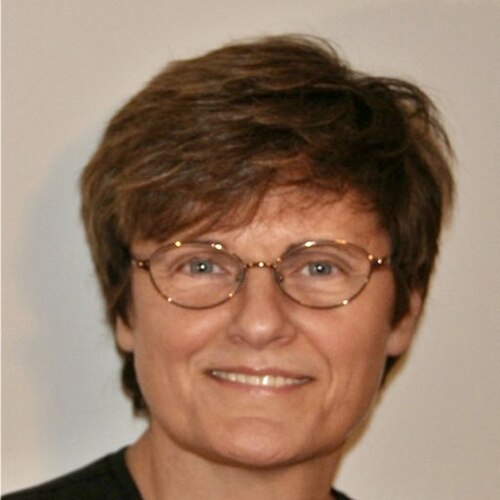
A biochemist born in Hungary in 1955, Karikó spent decades convinced that mRNA could be turned into medicine, often without funding or recognition. With Weissman she showed in 2005 that swapping in a modified base lets synthetic mRNA escape the immune alarm. She later joined the company BioNTech and is a professor at the University of Szeged in Hungary.
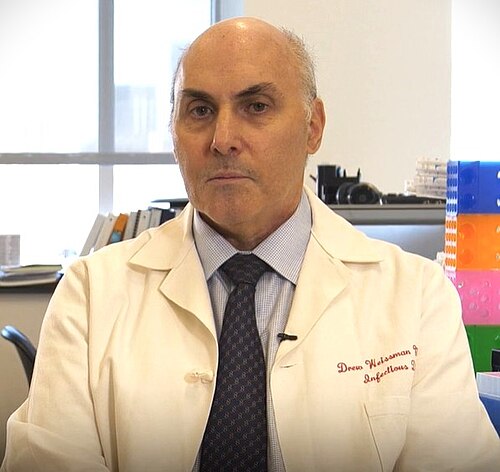
An immunologist born in the United States in 1959, Weissman met Karikó at the University of Pennsylvania in 1997 and paired his immunology with her RNA biochemistry. Their collaboration worked out why unmodified mRNA inflames cells and how a base swap stops it. He leads RNA research at the Penn Institute for RNA Innovations in Philadelphia.
Sources
Facts are pinned from the official Nobel Prize API. The explanations were written from these sources: