Fighting hunger to keep the peace
Awarded to World Food Programme “for its efforts to combat hunger, for its contribution to bettering conditions for peace in conflict-affected areas and for acting as a driving force in efforts to prevent the use of hunger as a weapon of war and conflict”.
1Pick your depth
What was the 2020 Nobel Prize in Peace awarded for?
The 2020 Nobel Peace Prize went to the World Food Programme, the United Nations agency that fights hunger around the world. The committee honoured it for feeding people in war zones and for pushing back against the use of starvation as a weapon. Its core message was simple: you cannot build lasting peace while people are going hungry.
2Guess first
Feeding hungry people is clearly a good thing, but it sounds like humanitarian aid, not peace work. So why did the Nobel Committee call it a Peace Prize?
How close were you?
3Learn it at ELI5
ELI5 done
Read the transcript
David Beasley was in a meeting in Niger when news came in. His team had won the Nobel Peace Prize. For the first time in his life, he said, he had no words. He led the World Food Programme, which brings food to hungry people. Many hungry people live amid war. In some wars, people are starved on purpose. His team pushes to stop that. David says nobody in the world should go to bed hungry. In 2019, his team helped close to 100 million people in 88 countries.
Undergrad done
Read the transcript
In a children's hospital in war-torn Yemen, David Beasley saw a little girl's feet under the covers. Thinking of his own daughters, he tickled them. She did not giggle or move. He left the room and wept, because help had come too late. Beasley led the World Food Programme, the world's largest humanitarian group fighting hunger. In 2019, 135 million people faced acute hunger, and war and armed conflict caused most of the rise. The Nobel Committee calls hunger and conflict a vicious circle. War causes hunger, and hunger can make old conflicts flare into violence. Food aid can improve the prospects for peace. With the 2020 Peace Prize, the Committee wanted to turn the eyes of the world toward the millions facing hunger.
Expert done
Read the transcript
On 10 December 2020, David Beasley gave the World Food Programme's acceptance speech from Rome. Earlier Peace Prizes for the fight against hunger went to John Boyd Orr in 1949 and Norman Borlaug in 1970. The citation stresses the programme's role against hunger as a weapon of war. The programme took part in the diplomacy behind UN Security Council Resolution 2417, adopted in May 2018, which condemned starvation as a method of warfare. The Committee also cited the pandemic. It quoted the programme's own line, that until there is a medical vaccine, food is the best vaccine against chaos. It called the UN's largest specialised agency a modern version of the peace congresses that Nobel's prize was meant to promote. In Rome, Beasley warned that 270 million people were marching toward starvation. He said 5 billion dollars would save 30 million lives from famine.
The 2020 Peace Prize did not go to a person. It went to an organisation: the World Food Programme, often shortened to WFP. It is part of the United Nations, and its job is to get food to people who do not have enough, especially in places torn apart by war and disaster.
Why would feeding people win a peace prize? Because hunger and war are tied together. When fighting breaks out, farms are destroyed and food cannot reach people, so they go hungry. And when people are desperate and hungry, that desperation can spark even more conflict. WFP works to break that cycle by delivering food where it is needed most.
Not one winner, but thousands
The Peace Prize can go to an institution, not just a person. WFP is the world's largest humanitarian organisation, with tens of thousands of staff. In 2019 it reached close to 100 million people in 88 countries. Its executive director, David Beasley, accepted the award on behalf of all of them.
The World Food Programme was founded in 1961 and is the United Nations agency for food assistance, headquartered in Rome. By 2020 it was the world's largest humanitarian organisation, running on voluntary donations from governments, companies, and individuals rather than a fixed budget. Roughly two-thirds of its work takes place in countries scarred by conflict, where people are far more likely to be undernourished than those living in peace.
Hunger and conflict feed each other
The Norwegian Nobel Committee described the link between hunger and armed conflict as a vicious circle. War destroys harvests, blocks supply routes, and drives people from their homes, which creates hunger. Hunger and scarcity, in turn, can make fragile societies even more unstable and tip them back into violence. The committee argued that food assistance does not only feed people; it can also improve the prospects for stability and peace.
What WFP does
- Emergency relief: delivering food and cash to people caught in wars, famines, and natural disasters, often in dangerous, hard-to-reach places.
- Building resilience: helping communities recover and feed themselves over the long term, and running the world's largest school-meals programme.
- Shaping policy: WFP was an active participant in the diplomatic process behind UN Security Council Resolution 2417, adopted in 2018, which for the first time condemned the use of starvation as a weapon of war.
The scale of hunger when WFP won
Figures the Nobel Committee pointed to in 2020
The 2020 prize landed in the middle of a worsening global picture. In 2019, the number of people suffering acute hunger had climbed to 135 million, the highest in years, and most of that rise was driven by war and armed conflict. The COVID-19 pandemic was compounding the crisis, and the committee warned that the number of people on the brink of starvation could rise sharply in the year ahead. Since the United Nations made ending hunger a Sustainable Development Goal in 2015, WFP has been the primary instrument for reaching it, and roughly two-thirds of its work sits in conflict-affected countries. Awarding the prize to WFP was partly a spotlight on that emergency and an appeal for the funding the agency said it urgently needed.
Resolution 2417 and hunger as a war crime
One of the committee's specific reasons was WFP's role in the diplomatic process behind UN Security Council Resolution 2417, adopted unanimously in May 2018. For the first time, the Security Council explicitly addressed the link between conflict and hunger, condemned the use of starvation of civilians as a method of warfare, and affirmed that it may constitute a war crime. It also stressed member states' duty to let food assistance reach those in need.
Context, impact, and debate
- A familiar Nobel choice: the committee has often used the Peace Prize to honour humanitarian institutions, from the Red Cross to UN agencies, rather than only peace negotiators.
- The funding message: accepting the award, David Beasley used it to press wealthy nations and billionaires to step up, warning that without billions of dollars in extra support, millions of people could face famine.
- Criticism and questions: some observers asked whether a large UN agency, dependent on government donations and itself part of the international system, was a conventional peacemaker, and noted that food aid can struggle with delivery, neutrality, and dependency in active war zones.
- The core claim stands: by tying the prize to hunger, the committee insisted that fighting starvation and building peace are not separate causes but two sides of the same work.
A funding plea, from the podium
Accepting the prize for WFP, executive director David Beasley turned the moment into an appeal. He warned that the world stood on the edge of a hunger crisis of historic scale and urged the wealthiest people and nations to step up, saying that billions of dollars were needed to pull tens of millions of people back from the brink of famine.
4Check yourself
Why did an agency that delivers food win the Nobel Peace Prize?
What did UN Security Council Resolution 2417, which WFP helped bring about, establish?
The 2020 laureate was unusual in one structural way. What was it?
Key terms
- World Food Programme (WFP)
- The United Nations agency for food assistance, founded in 1961 and based in Rome. It is the world's largest humanitarian organisation and funds its work through voluntary donations.
- Food insecurity
- Not having reliable access to enough safe, nutritious food. Acute food insecurity is the severe, life-threatening form that emergencies and conflict can cause.
- Resolution 2417
- A UN Security Council resolution adopted in 2018 that condemned the use of starvation of civilians as a method of warfare and recognised it may constitute a war crime.
- Humanitarian organisation
- A body that provides relief such as food, water, and medical care to people affected by crises like war and natural disaster, in principle on a neutral and needs-based basis.
- Vicious circle
- A chain of events in which each problem worsens the next, as when war causes hunger and hunger in turn fuels more conflict.
The laureate
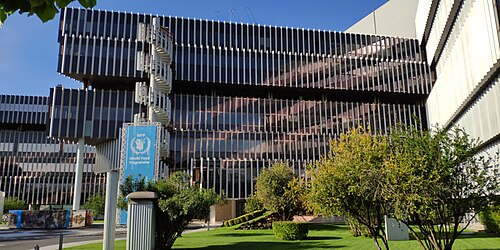
The World Food Programme is the United Nations agency for food assistance, founded in 1961 and based in Rome. It is the world's largest humanitarian organisation, funded by voluntary donations rather than a fixed budget, and in 2019 it reached close to 100 million people in 88 countries. Its executive director at the time, David Beasley, accepted the prize on its behalf.
Sources
Facts are pinned from the official Nobel Prize API. The explanations were written from these sources: