The reporters who would not stay quiet
Awarded to Maria Ressa and Dmitry Muratov “for their efforts to safeguard freedom of expression, which is a precondition for democracy and lasting peace”.
1Pick your depth
What was the 2021 Nobel Prize in Peace awarded for?
The 2021 Peace Prize went to two journalists: Maria Ressa of the Philippines, who co-founded the news site Rappler, and Dmitry Muratov of Russia, the longtime editor of the newspaper Novaya Gazeta. They won for defending free, fact-based journalism in two countries where reporters face arrest, lawsuits, and violence for telling the truth.
2Guess first
Ressa and Muratov did not stop a war or sign a treaty. So why does running a newsroom count as peace work?
How close were you?
3Learn it at ELI5
ELI5 done
Read the transcript
One October morning, Dmitry Muratov's mother phoned to ask how things were going. We've got the Nobel Prize, he told her. That's nice, she said. Anything else? Dmitry helped start a newspaper in Russia that reports what powerful people would rather hide. That work is dangerous. Six of the paper's reporters have been killed. Far away in the Philippines, Maria Ressa runs a news website that shows how lies spread online. The two shared the 2021 Nobel Peace Prize, for standing up for the right to speak freely.
Undergrad done
Read the transcript
On 8 October 2021, Maria Ressa was live at another event when Oslo called. I'm speechless, she said. She had to keep the news to herself until 11 o'clock. In 2012 she co-founded Rappler, an investigative news site in the Philippines. It turned a critical eye on President Duterte's murderous anti-drug campaign. It also documented how social media spreads fake news and harasses opponents. Dmitry Muratov helped found Russia's Novaya Gazeta in 1993. It reports on corruption and electoral fraud. Its journalist Anna Politkovskaya, who wrote revealing articles on the war in Chechnya, was murdered. The Nobel Committee sees free, fact-based journalism as a protection against lies and war propaganda. Ressa became only the 18th woman to receive the Peace Prize.
Expert done
Read the transcript
When Maria Ressa was first arrested in 2019, the officer told her he was only doing his job. He lowered his voice almost to a whisper as he read her rights. In less than 2 years, the Philippine government filed 10 arrest warrants against her. The charges she faces could mean about 100 years in jail. Ressa cited studies showing that lies laced with anger and hate spread faster and further than facts on social media. Dmitry Muratov co-founded Novaya Gazeta in 1993. In Oslo he noted that over a hundred journalists and groups had been branded foreign agents. He dedicated the prize to colleagues who lost their lives, and asked the hall for a minute of silence. Ressa recalled that the last working journalist to win, Carl von Ossietzky, never made it to Oslo from a Nazi concentration camp.
The 2021 Peace Prize went to two journalists: Maria Ressa from the Philippines and Dmitry Muratov from Russia. They won for fighting to keep the press free in two countries where reporters can be jailed, sued, or even killed for their work.
Ressa co-founded a news website called Rappler, which investigates the powerful and shows how false stories spread online. Muratov helped start and then led a newspaper called Novaya Gazeta, which exposed corruption and abuses of power in Russia. Both kept reporting the truth even when it was dangerous.
The first reporters honoured in 86 years
Ressa and Muratov were the first journalists to win the Peace Prize since 1935. The Nobel Committee wanted to send a message: a free press that people can trust is not a luxury. It is one of the things that protects democracy and helps keep the peace.
The Nobel Committee argued that free, fact-based journalism is a defence against abuse of power, lies, and war propaganda. When the press can investigate and report without fear, the public stays informed and leaders can be held to account. Ressa and Muratov worked on opposite sides of the world and never ran the same newsroom, but the Committee honoured them together as representatives of all journalists who defend that ideal in places where it is increasingly under threat.
Two journalists, two hard countries
- Maria Ressa (Philippines): a former CNN investigative reporter who co-founded the digital news site Rappler in 2012. Rappler exposed the deadly anti-drug campaign under President Rodrigo Duterte and documented how social media is used to spread disinformation and harass critics. Ressa has faced a string of lawsuits and a cyber-libel conviction widely seen as politically motivated.
- Dmitry Muratov (Russia): helped found the independent newspaper Novaya Gazeta in 1993 and edited it for most of the next three decades. The paper published hard-hitting investigations into corruption, police violence, and election fraud. Six of its journalists have been killed for their work, among them Anna Politkovskaya, who reported on the war in Chechnya.
Free expression as a precondition for peace
The Committee's citation calls freedom of expression 'a precondition for democracy and lasting peace.' The reasoning is that informed citizens and an accountable government are what keep societies stable. By honouring two working journalists under pressure, the prize tied the survival of independent media to the prevention of conflict.
The 2021 prize landed at a moment of broad democratic backsliding and rising hostility toward the press. The Committee framed Ressa and Muratov as stand-ins for journalists everywhere working 'in a world in which democracy and freedom of the press face increasingly adverse conditions.' They were the first journalists to receive the Peace Prize since the German writer Carl von Ossietzky in 1935, a choice that itself signalled how seriously the Committee viewed the threat. Both had spent decades building independent outlets from the ground up, one in the early internet era and one in the chaotic years after the Soviet collapse, and both had paid for it.
Honoured while under threat
Neither laureate worked in safety. Ressa faced multiple criminal charges in the Philippines and a cyber-libel conviction that carried the risk of prison, charges she and press-freedom groups called an attempt to silence Rappler. In Russia, Novaya Gazeta suspended publication in March 2022 under wartime censorship laws, and Muratov was later attacked with red paint laced with acetone aboard a train.
Context, impact, and the debate it stirred
- A signal to authoritarians: by honouring journalists in the Philippines and Russia, the Committee pushed back against the idea that a controlled press is normal or acceptable.
- Disinformation as a frontline issue: Ressa's work made the prize partly about how social media platforms amplify falsehoods and harassment, widening 'freedom of expression' to include the health of the information ecosystem.
- The Navalny criticism: some observers argued the Committee should have honoured the jailed Russian opposition leader Alexei Navalny, reading the choice of Muratov as a way to keep distance from Russia's domestic politics.
- An act of solidarity: in June 2022 Muratov auctioned his Nobel medal for a record $103.5 million and gave the proceeds to UNICEF for children displaced by Russia's invasion of Ukraine.
“A world in which democracy and freedom of the press face increasingly adverse conditions.”The Norwegian Nobel Committee, 2021
A medal turned into $103 million of aid
In June 2022 Dmitry Muratov auctioned his Nobel Peace Prize medal in New York. It sold for a record $103.5 million, and he gave every cent to UNICEF to help children displaced by Russia's invasion of Ukraine, by far the most ever paid for a Nobel medal.
4Check yourself
What did Maria Ressa and Dmitry Muratov win the 2021 Peace Prize for?
Why does the Nobel Committee treat defending a free press as peace work?
What was notable about Ressa and Muratov as Peace laureates?
Key terms
- Freedom of expression
- The right to seek, share, and publish information and opinions without censorship or punishment. The Nobel Committee called it 'a precondition for democracy and lasting peace.'
- Rappler
- The Philippine digital news site co-founded by Maria Ressa in 2012, known for investigative reporting on the Duterte government and on online disinformation.
- Novaya Gazeta
- The independent Russian newspaper Dmitry Muratov helped found in 1993 and edited for most of three decades, known for investigations into corruption and abuses of power.
- Disinformation
- False or misleading information spread deliberately, often through social media, to deceive the public or harass critics.
- Cyber libel
- A criminal charge for defamation published online. Ressa was convicted of it in the Philippines in a case press-freedom groups called politically motivated.
The laureates
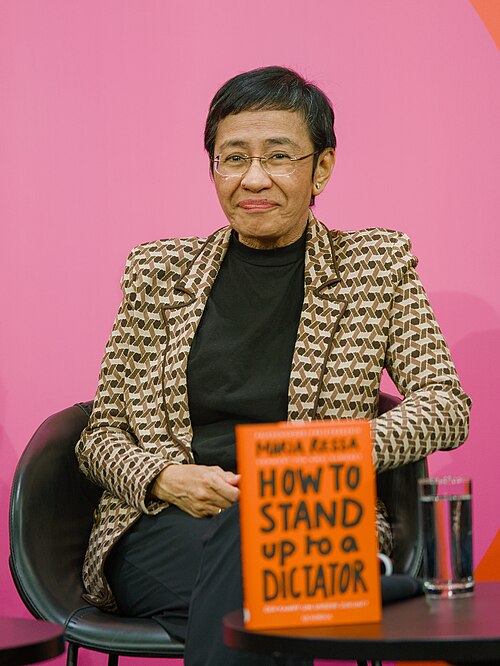
A Filipino-American journalist born in 1963, Ressa spent nearly two decades as a lead investigative reporter for CNN in Southeast Asia before co-founding the news site Rappler in 2012. As its CEO she turned critical attention on the Duterte government's deadly anti-drug campaign and on how social media spreads disinformation and harasses critics.
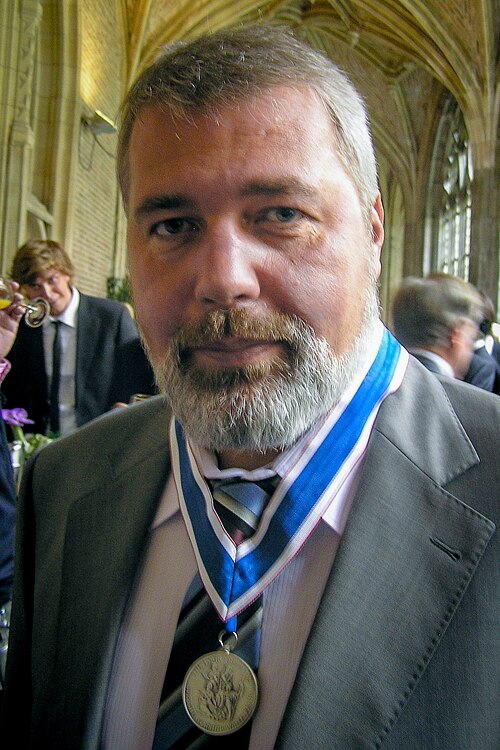
A Russian journalist born in 1961, Muratov helped found the independent newspaper Novaya Gazeta in 1993 and led it as editor-in-chief for most of the next three decades. Under his editorship the paper exposed corruption and abuses of power, and six of its journalists were killed in connection with their reporting.
Sources
Facts are pinned from the official Nobel Prize API. The explanations were written from these sources: