The prize that reached into a prison cell
Awarded to Narges Mohammadi “for her fight against the oppression of women in Iran and her fight to promote human rights and freedom for all”.
1Pick your depth
What was the 2023 Nobel Prize in Peace awarded for?
The 2023 Peace Prize went to Narges Mohammadi, an Iranian human rights activist who has spent decades fighting the oppression of women in Iran. She was locked in a Tehran prison cell when the prize was announced, and her teenage children read her acceptance speech in Oslo on her behalf.
2Guess first
Mohammadi was locked in a cell, unable to speak freely or travel. What does the Nobel Committee gain by giving its Peace Prize to someone the Iranian state is actively imprisoning?
How close were you?
3Learn it at ELI5
ELI5 done
Read the transcript
In Oslo, 17-year-old twins Kiana and Ali sat on either side of an empty chair. It was for their mother, Narges Mohammadi. She was in prison in Iran. They had not seen her for 8 years. Iran forces women to cover their hair. Narges has fought rules like that for over 20 years, even from prison. From her cell, she wrote a speech. Her children read it aloud. She had won the 2023 Nobel Peace Prize. At the ceremony, a photo she picked showed her smiling, with her hair uncovered.
Undergrad done
Read the transcript
In September 2023, Narges Mohammadi smuggled an article out of Evin prison in Tehran. The New York Times ran it a year after Mahsa Jina Amini was killed in morality police custody. She wrote that the more of us they lock up, the stronger we become. She had fought for equality since studying physics in the 1990s. In 2003 she joined the Defenders of Human Rights Center, founded by Nobel laureate Shirin Ebadi. Out on bail after her 2011 sentence, she campaigned against the death penalty. That work sent her back to prison in 2015, where she spoke out against the torture of political prisoners, especially women. When her Peace Prize was announced on 6 October 2023, she was still held in Evin.
Expert done
Read the transcript
On 6 October 2023, Committee chair Berit Reiss-Andersen opened the Peace Prize announcement in Farsi. Zan, Zendegi, Azadi. Woman, Life, Freedom. The slogan spread after Mahsa Jina Amini, a young Kurdish woman, was killed in morality police custody in September 2022. The Committee counts more than 500 demonstrators killed and at least 20,000 arrested. It chose Narges Mohammadi, who joined Tehran's Defenders of Human Rights Center in 2003. The regime has arrested her 13 times. Her sentences total 31 years in prison and 154 lashes. Inside Evin prison, she organised solidarity actions among fellow inmates. Her Nobel lecture, written there, calls the movement an accelerator of the democratic process. The Committee linked the award to Alfred Nobel's will. Only by embracing equal rights for all, it said, can the world achieve the fraternity between nations that Nobel sought to promote.
The 2023 Nobel Peace Prize was awarded to one person: Narges Mohammadi, a human rights activist from Iran. She won it for her long fight against the unfair treatment of women in Iran, and for defending the rights and freedom of everyone.
Mohammadi has spent most of her adult life standing up to the Iranian government, even though it keeps putting her in prison for doing so. When the prize was announced, she was locked in a cell in Tehran. She could not travel to Norway to collect it, so her two teenage children read her speech aloud at the ceremony instead.
Honoured behind bars
The Norwegian Nobel Committee chose Mohammadi while she sat in Evin Prison. By doing so it was not only praising one brave woman; it was also pointing to the hundreds of thousands of Iranians who had marched for women's rights under the slogan 'Woman, Life, Freedom'.
In Iran, women live under laws that treat them as unequal, including a compulsory dress code enforced by patrols known as the morality police. Narges Mohammadi has spent more than two decades challenging that system, and the wider crackdown on anyone who dissents, and she has paid for it with her freedom.
Her prize came a year after the death in custody of Mahsa Amini, a young woman detained for wearing her hijab 'improperly'. Amini's death set off nationwide protests under the slogan 'Woman, Life, Freedom', and the Committee said the award also honoured the hundreds of thousands of people who took to the streets.
A campaign that never stopped
What sets Mohammadi apart is persistence under punishment. Each time she was released she returned to the same work: defending political prisoners, opposing executions, and exposing torture. The Committee framed her decades of activism, much of it carried on from inside prison, as a fight not only for Iranian women but for human rights and freedom for all.
The 2023 prize was widely read as a direct response to the 'Woman, Life, Freedom' uprising. Those protests had erupted in September 2022 after 22-year-old Mahsa Amini died in the custody of Iran's morality police, and they grew into one of the most serious challenges to the Islamic Republic in years. By honouring Mohammadi, who had championed these same causes long before the protests began, the Committee tied one woman's record to a mass movement and to Iran's wider treatment of women and use of capital punishment.
Thirteen arrests, thirty-one years
Mohammadi's struggle has carried an extraordinary price. The Iranian authorities have arrested her 13 times, convicted her five times, and sentenced her to a combined 31 years in prison and 154 lashes. She was still being held in Evin Prison when the Committee named her, and she remained there as the citation was read aloud in Oslo.
Context, impact, and debate
- Death penalty: after an early release, Mohammadi led a campaign against executions in a country that puts more of its people to death, by share of population, than almost any other. More than 860 prisoners were executed in Iran in the period the Committee cited.
- 'White torture': from inside prison she documented prolonged solitary confinement and sexualised violence against women prisoners, work gathered in her 2022 book of interviews.
- An organisation, not just an individual: the prize again spotlighted the Defenders of Human Rights Center, making Mohammadi the second figure from it, after Shirin Ebadi in 2003, to win the Peace Prize.
- Recognition for a movement: the Committee stated that the award also honoured the hundreds of thousands of Iranians who protested under 'Woman, Life, Freedom'.
- A recurring choice: as with several recent Peace Prizes, the Committee honoured someone the criticised state was actively imprisoning.
Mohammadi has refused to soften her stance from inside her cell. She has continued to issue statements and smuggle out writing, insisting that the movement for women's rights and human dignity would outlast any single activist.
The award was not universally welcomed. Iran's government condemned it as a political and interventionist act, while leaders in the West, including US President Joe Biden, praised the choice. That split captured how contested the prize was: inside Iran the state cast it as foreign meddling, while for the protest movement it was rare international recognition. The Committee placed Mohammadi in a long line of laureates honoured while imprisoned by the very governments they challenged, a choice that tests whether global attention can shield an activist or simply provoke harsher treatment.
“Only by embracing equal rights for all can the world achieve the fraternity between nations that Alfred Nobel sought to promote.”Norwegian Nobel Committee, 2023 announcement
Her children read the speech she could not give
When Narges Mohammadi won the prize she was locked in Evin Prison and could not travel to Oslo. The text of her Nobel lecture was smuggled out of prison, and at the December ceremony it was read aloud on her behalf by her teenage children, Ali and Kiana Rahmani.
4Check yourself
Why was Narges Mohammadi unable to collect her 2023 Nobel Peace Prize in person?
What did the Nobel Committee honour Mohammadi for?
The slogan 'Woman, Life, Freedom' is tied to the prize. Where did it come from?
Key terms
- Woman, Life, Freedom (Zan, Zendegi, Azadi)
- The rallying slogan of the protest movement that swept Iran in 2022, calling for women's rights and an end to compulsory rules on how women dress and live.
- Defenders of Human Rights Center (DHRC)
- A Tehran-based human rights organisation founded in 2001 by lawyers including Shirin Ebadi. Mohammadi joined in 2003 and became its deputy head.
- Morality police
- Iranian patrols that enforce the country's strict dress code, including the compulsory hijab for women. Mahsa Amini was detained by such a patrol shortly before her death in 2022.
- Evin Prison
- A Tehran prison long used to hold political prisoners and activists in Iran. Mohammadi was held there when she won the Nobel Peace Prize.
- White torture
- Mohammadi's term for prolonged solitary confinement and sensory isolation, the subject of her 2022 book of interviews with women prisoners.
The laureate
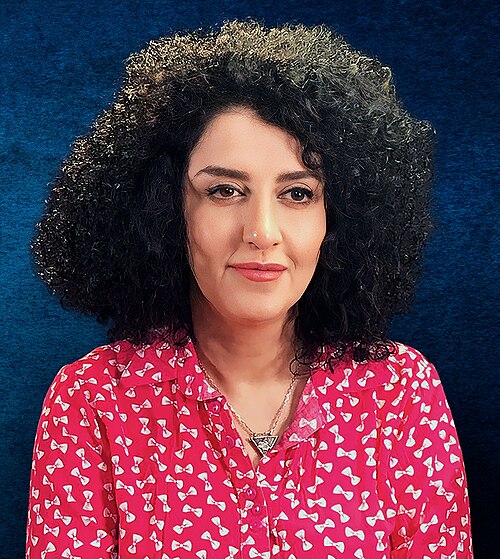
Born in Iran in 1972, Mohammadi trained as a physicist and worked as an engineer and a newspaper columnist before devoting herself to activism. In 2003 she joined the Defenders of Human Rights Center in Tehran, the organisation founded by fellow Nobel laureate Shirin Ebadi, and rose to become its deputy head. By the time she won the prize, the Iranian authorities had arrested her 13 times and sentenced her to a total of 31 years in prison and 154 lashes.
Sources
Facts are pinned from the official Nobel Prize API. The explanations were written from these sources: