The survivors who made the bomb unthinkable
Awarded to Nihon Hidankyo “for its efforts to achieve a world free of nuclear weapons and for demonstrating through witness testimony that nuclear weapons must never be used again”.
1Pick your depth
What was the 2024 Nobel Prize in Peace awarded for?
The 2024 Peace Prize went to Nihon Hidankyo, a Japanese grassroots organisation of survivors of the atomic bombings of Hiroshima and Nagasaki, known as the hibakusha. For nearly seventy years they have told the world what nuclear weapons do to human beings, helping to build and sustain the 'nuclear taboo', the shared conviction that such weapons must never be used again.
2Guess first
Nihon Hidankyo never disarmed a single warhead or signed a treaty. So why does telling survivors' stories count as work worth a Peace Prize?
How close were you?
3Learn it at ELI5
ELI5 done
Read the transcript
In August 1945, Terumi Tanaka was 13 and at home in Nagasaki. A bright white light filled everything. An atomic bomb had exploded over his city. Terumi found himself under a big glass door, but not one piece had broken. Many people were hurt or died. Survivors like Terumi are called hibakusha. In 1956 they formed Nihon Hidankyo. They kept telling their stories, so nobody would ever use such a bomb again. In 2024 their group won the Nobel Peace Prize. At 92, Terumi told his story in Oslo.
Undergrad done
Read the transcript
Toshiyuki Mimaki pinched his cheek in Hiroshima on 11 October 2024, to check he was not dreaming. His survivors' group, Nihon Hidankyo, had just won the Nobel Peace Prize. Mimaki was 3 when the bomb hit Hiroshima in August 1945. Hidankyo says the occupying forces kept survivors silent for 7 years, and their own government neglected them. In 1956 survivor groups joined with victims of nuclear tests in the Pacific. They collected thousands of witness accounts and sent yearly delegations to the United Nations. The Nobel Committee says this testimony helped build the nuclear taboo, a shared belief that using these weapons is morally unacceptable. No nuclear weapon has been used in war since 1945. The Committee warns that this taboo is now under pressure.
Expert done
Read the transcript
On 1 March 1954, fallout from an American hydrogen bomb test at Bikini Atoll fell on the fishing boat Daigo Fukuryu Maru. All 23 crew members developed acute radiation sickness. A national petition to ban the bomb gathered over 30 million signatures. On 10 August 1956 in Nagasaki, A-bomb survivors founded Nihon Hidankyo, demanding state compensation and the abolition of nuclear weapons. They won a medical care law in 1957. Japan's government, the group says, still refuses state compensation for the dead. From 2013, hibakusha testified at 3 conferences on the humanitarian impact of nuclear weapons. An appeal proposed by the confederation gathered 13.7 million signatures. On 7 July 2017, 122 countries adopted the Treaty on the Prohibition of Nuclear Weapons. In its Nobel lecture, Nihon Hidankyo put the survivors' average age at 85. It hoped the next generation would take the movement further.
The 2024 Peace Prize went to a single Japanese organisation called Nihon Hidankyo. Its members are survivors of the atomic bombs dropped on Hiroshima and Nagasaki in 1945. In Japanese these survivors are called the hibakusha.
For almost seventy years the hibakusha have done one brave and simple thing: they tell people exactly what a nuclear bomb did to them, their families, and their cities. By sharing those painful memories again and again, they help the whole world understand that nuclear weapons must never be used again.
Turning suffering into a warning
Many survivors were burned, lost their families, and faced unfair treatment for years afterwards. Instead of staying silent, they chose to speak. The Nobel Committee honoured them for using their own hard experience to give the world a clear warning.
On 6 and 9 August 1945 two atomic bombs killed roughly 200,000 people in Hiroshima and Nagasaki. For nearly a decade afterwards the survivors received little help, and during the US occupation they were largely prevented from speaking publicly about what had happened. Many also faced discrimination over marriage and work, because the public wrongly feared that radiation sickness was contagious or inherited.
What Nihon Hidankyo has done
- Organised in 1956: local survivor groups joined with people harmed by nuclear test fallout in the Pacific to form the Japan Confederation of A- and H-Bomb Sufferers Organisations, shortened to Nihon Hidankyo.
- Collected testimony: it gathered thousands of firsthand witness accounts of the bombings and their lifelong effects.
- Campaigned globally: it issued resolutions and public appeals and sent delegations to the United Nations and peace conferences, first petitioning for a total ban on nuclear weapons as early as 1974.
- Pressed two governments at once: it lobbied Japan to support the survivors and lobbied the wider world to abolish nuclear weapons.
- Carried the message forward: it has worked to pass survivors' testimony to younger generations so the warning outlives the witnesses themselves.
Evidence that becomes a moral barrier
The Committee's argument is that firsthand testimony does something that arguments alone cannot. By making the human cost of nuclear weapons impossible to ignore, the hibakusha helped build what scholars call the nuclear taboo: a widely shared sense that using these weapons would be illegitimate and immoral. No nuclear weapon has been used in war in nearly eighty years.
Nihon Hidankyo was founded in August 1956, partly in response to the Lucky Dragon incident of 1954, when fallout from a US hydrogen bomb test at Bikini Atoll contaminated a Japanese fishing crew and galvanised a national anti-nuclear movement. The new confederation united survivors of Hiroshima and Nagasaki with these test victims under a single demand: state support for the injured and the abolition of nuclear weapons. Its work began against a backdrop of official silence, because occupation authorities had restricted reporting on the bombings until Japan regained sovereignty in 1952.
The nuclear taboo and its makers
Political scientist Nina Tannenwald described the nuclear taboo as a normative 'bright line' separating use from non-use, distinct from cold deterrence logic such as mutually assured destruction. The 2024 prize credits the hibakusha with helping to create and sustain that norm through decades of personal testimony, placing Nihon Hidankyo alongside earlier disarmament laureates such as ICAN, honoured in 2017.
When the prize was announced in October 2024, about 100,000 hibakusha were still alive, most of them now in their eighties. The Committee paired its tribute with a warning: the taboo is 'under pressure', because nuclear states are modernising their arsenals, more countries appear to be seeking the bomb, and nuclear threats have returned to active conflicts.
Context, impact, and debate
- An idea, not a treaty: the prize honours a norm rather than a signed agreement, betting that shared moral conviction can restrain power where formal arms control has stalled.
- A contested explanation: some scholars credit non-use to cold deterrence such as mutually assured destruction rather than any taboo, so the award endorses one influential but debated reading of history.
- A line of laureates: the choice extends a long Nobel tradition of honouring nuclear disarmament and arms control, following groups and figures such as ICAN, recognised in 2017, this time crowning grassroots survivors rather than statesmen or treaties.
- From victims to teachers: by passing their accounts to younger Japanese and to audiences abroad, the hibakusha aim to keep the warning alive after the last of them are gone, a concern the Committee underlined for a generation that has no living memory of 1945.
A warning that has held for eighty years
No nuclear weapon has been used in war since Nagasaki in 1945, even though nine states now hold them. The Nobel Committee credited the hibakusha with helping build the taboo behind that record, while warning in the same breath that it is now 'under pressure' from new arsenals and fresh nuclear threats.
4Check yourself
Who are the hibakusha?
What is the 'nuclear taboo' the prize refers to?
Why did the Committee call this an urgent, even alarming, moment to give the prize?
Key terms
- Hibakusha
- The Japanese word, meaning 'bomb-affected people', for the survivors of the atomic bombings of Hiroshima and Nagasaki in 1945.
- Nihon Hidankyo
- Short Japanese name for the Japan Confederation of A- and H-Bomb Sufferers Organisations, the nationwide group of survivors founded in 1956 and awarded the 2024 Peace Prize.
- Nuclear taboo
- The widely shared international norm that using nuclear weapons would be illegitimate and immoral, often used to explain why none has been used in war since 1945.
- Nuclear disarmament
- The effort to reduce and ultimately eliminate nuclear weapons, the long-standing goal of Nihon Hidankyo's campaigning.
The laureate
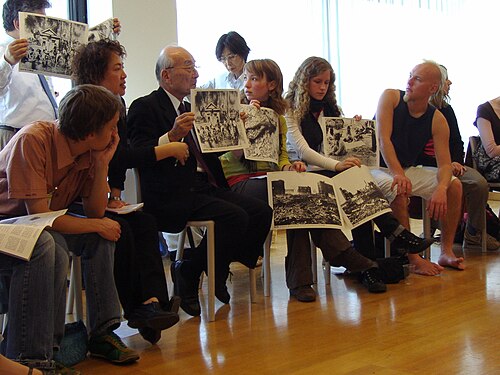
The Japan Confederation of A- and H-Bomb Sufferers Organisations, shortened in Japanese to Nihon Hidankyo, was founded in 1956 by survivors of the atomic bombings of Hiroshima and Nagasaki, together with people harmed by nuclear test fallout in the Pacific. It grew into the largest and most influential organisation of hibakusha in Japan, gathering thousands of witness accounts and campaigning worldwide for the abolition of nuclear weapons.
Sources
Facts are pinned from the official Nobel Prize API. The explanations were written from these sources: