Keeping the flame of democracy burning
Awarded to Maria Corina Machado “for her tireless work promoting democratic rights for the people of Venezuela and for her struggle to achieve a just and peaceful transition from dictatorship to democracy”.
1Pick your depth
What was the 2025 Nobel Prize in Peace awarded for?
The 2025 Nobel Peace Prize went to Maria Corina Machado, the best known leader of Venezuela's democratic opposition. The Norwegian Nobel Committee honoured her for uniting a fractured opposition and pressing for a peaceful, lawful path out of authoritarian rule, even after the government barred her from the ballot and forced her into hiding.
2Guess first
Machado never negotiated a ceasefire or signed a treaty, the things we usually link to a Peace Prize. So why does leading a national opposition count as peace work?
How close were you?
3Learn it at ELI5
ELI5 done
Read the transcript
On 10 October 2025, a man in Oslo phoned Maria Corina Machado. She had won the Nobel Peace Prize. "Oh my God," she said. "I have no words." Machado lives in Venezuela. For more than 20 years, she has asked for fair elections there. The government blocked her from running for president, so she helped another candidate instead. She kept pushing for change through votes, in a peaceful way. The Nobel Committee called her a brave champion of peace who keeps the flame of democracy burning.
Undergrad done
Read the transcript
On 28 July 2024, opposition volunteers in Venezuela collected copies of the official tally sheets. By Maria Corina Machado's account, some arrived by mule and even by canoe. Authorities had barred Machado, the opposition's candidate, from office for 15 years. She backed Edmundo Gonzalez Urrutia instead. The opposition published its count, which gave Gonzalez 67 percent. The electoral council declared Nicolas Maduro the winner without publishing tallies. The Carter Center said the vote could not be considered democratic. The Norwegian Nobel Committee called the opposition's effort peaceful and democratic. It noted hundreds of thousands of volunteers trained as election observers. Machado said she went into hiding after the vote. On 10 December 2025, her daughter Ana Corina Sosa gave her Nobel lecture in Oslo.
Expert done
Read the transcript
In 2002, the engineer Maria Corina Machado helped found Súmate, a group that trained election monitors. She has called it a choice of ballots over bullets. In 2010 she entered the National Assembly with a record vote. In 2014, after she spoke at the Organization of American States, the pro-government majority removed her. In 2023 she won the opposition primary with over 90 percent. A 15 year ban from office, upheld by the Supreme Tribunal, kept her off the 2024 ballot. The Norwegian Nobel Committee weighed her against the criteria in Alfred Nobel's will. It cited her role in uniting a divided opposition, and her steady support for a peaceful transition. The Committee's central claim is that democracy is a precondition for lasting peace. In 2024, it noted, more elections were held than ever before, while fewer of them were free and fair.
The 2025 Nobel Peace Prize went to one person: Maria Corina Machado, the best known leader of the opposition in Venezuela. For years her country has been run by an authoritarian government, first under Hugo Chavez and then Nicolas Maduro, and speaking out against it can mean prison or exile.
Machado won the prize for keeping up a peaceful fight for democracy. When the government banned her from running for president, she backed a stand in candidate and helped the opposition gather proof that it had actually won the vote. The authorities still claimed victory, and Machado had to go into hiding. The Nobel Committee honoured her courage and her insistence on change through votes rather than violence.
Honoured while in hiding
Machado could not travel to celebrate. A government travel ban and the threat of arrest kept her inside Venezuela, in hiding, when the prize was announced in October 2025.
Venezuela is a textbook case of democratic backsliding: a country that still holds elections, but where the government controls the courts, the electoral authority, and much of the media, and disqualifies or jails its strongest challengers. For years the opposition was fractured, with rival leaders, personal rivalries, and competing strategies over whether to vote or to boycott, which made it easy for the government to divide and sideline.
What Machado actually did
- Built democratic muscle from civil society. In 1992 she founded the Atenea Foundation for street children, and in 2002 co-founded Sumate, a group that promotes free and fair elections and trains election monitors.
- Won power at the ballot box, then lost it to the regime. Elected to the National Assembly in 2010 with a record vote, she was stripped of her seat in 2014. She went on to lead the Vente Venezuela party.
- United a divided opposition. In the 2023 opposition primary she won roughly 90 percent of the vote and became the single unity candidate, the first time in years the movement rallied behind one person.
- Kept the fight peaceful when blocked. Barred from the ballot by a 15 year disqualification, she backed the substitute candidate Edmundo Gonzalez and helped the opposition collect copies of the official vote tallies, which showed Gonzalez had won the 2024 election.
Unity, elections, and non-violence
The Norwegian Nobel Committee said Machado met all three conditions in Alfred Nobel's will. She brought a divided opposition together, she resisted the militarisation of Venezuelan society, and she stayed committed to a peaceful transition from dictatorship to democracy.
The award lands in a long arc of Venezuelan crisis. Under Hugo Chavez and his successor Nicolas Maduro, the country slid from a flawed democracy into one party dominance, mass emigration, and economic collapse. The 2024 presidential election became the flashpoint: international observers, including the Carter Center and the United States, judged that the results announced by the government were not credible, and that the opposition's tally sheets pointed to a clear win for Edmundo Gonzalez. Maduro was nonetheless sworn in for a third term in January 2025.
A laureate in hiding
Machado has paid a steep price. In 2023 the authorities disqualified her from public office for 15 years on contested administrative grounds, a ban the Supreme Tribunal upheld. After the 2024 vote she went into hiding inside Venezuela, citing threats to her life and freedom, and a long standing travel ban meant she could not leave the country to receive the prize.
Context, impact, and the debate it stirred
- Democracy in retreat, globally. The Committee framed the prize as a defence of democracy at a moment when authoritarianism is advancing in many countries, not only in Venezuela.
- A polarising figure at home. Machado sits on the right of Venezuelan politics. She has backed US sanctions on the Maduro government, favours privatising the state oil company, and has praised leaders such as Argentina's Javier Milei, which her critics on the left cite to argue the prize blessed a hardline agenda.
- The Maduro government rejected it. Officials and their supporters cast Machado as a US aligned figure in a Washington backed push for regime change, and dismissed the award as foreign interference.
- A contested dedication. Machado dedicated the prize to the suffering people of Venezuela and to US President Donald Trump for his support of her cause, a gesture that drew both praise and sharp criticism.
- Civilian courage over heads of state. As with several recent Peace Prizes, the Committee honoured a grassroots democracy movement and its leader rather than a sitting government or a signed treaty.
The Committee's underlying claim is the one that runs through many Peace Prizes: that free elections, an opposition allowed to compete, and the rejection of force are the foundations of lasting peace, both within a country and between states. By that logic, defending the vote in Venezuela counts as peace work, even without a ceasefire or a treaty to point to. The choice also extends a recent pattern, after laureates such as Narges Mohammadi in Iran and Belarus's Ales Bialiatski, of honouring individuals who resist authoritarian rule from within rather than statesmen who broker deals between governments.
She could not leave to accept it
When the prize was announced in October 2025, Maria Corina Machado was in hiding inside Venezuela. A long standing government travel ban and the risk of arrest meant the year's foremost champion of peace could not appear freely in public, let alone fly to Oslo.
4Check yourself
What did Maria Corina Machado win the 2025 Peace Prize for?
Why could Machado not run in Venezuela's 2024 presidential election?
What does the Nobel Committee count as the heart of Machado's peace work?
Key terms
- Chavismo
- The political movement built around Hugo Chavez and continued by Nicolas Maduro, which has governed Venezuela since 1999 and which Machado's opposition seeks to replace.
- Vente Venezuela
- The liberal, pro free market opposition party founded and led by Maria Corina Machado.
- Sumate
- A Venezuelan civil society group Machado co-founded in 2002 to promote free and fair elections and to train election monitors.
- Disqualification (inhabilitacion)
- An administrative ban that bars a person from holding or running for public office. Venezuelan authorities used a 15 year ban to keep Machado off the 2024 ballot.
- Vote tally sheets (actas)
- The official precinct level result sheets from a polling station. Machado's opposition collected copies to argue that its candidate, not Maduro, had won the 2024 election.
The laureate
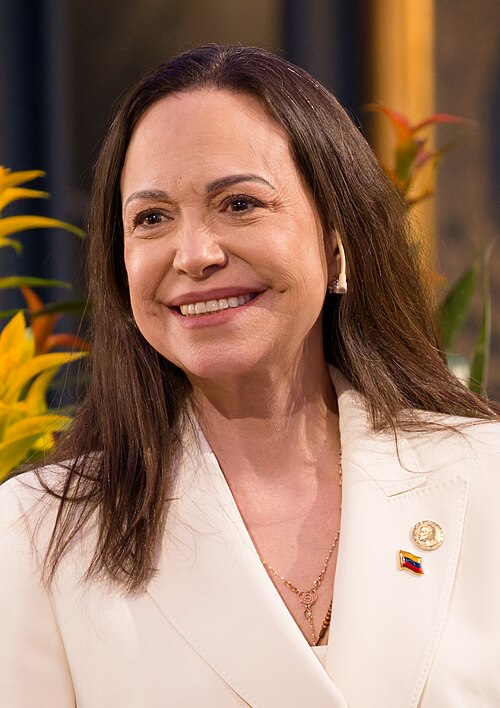
A Venezuelan industrial engineer who came to politics through civil society. In 1992 she founded the Atenea Foundation for street children in Caracas, and in 2002 co-founded Sumate, a group that promotes free and fair elections. Elected to the National Assembly in 2010 with a record vote and expelled in 2014, she leads the Vente Venezuela party. She won the opposition's 2023 primary in a landslide and was honoured while in hiding inside Venezuela. Born 1967.
Sources
Facts are pinned from the official Nobel Prize API. The explanations were written from these sources: