Black holes are real: from Einstein's equations to the heart of the Milky Way
Awarded to Roger Penrose, Reinhard Genzel and Andrea Ghez “for the discovery that black hole formation is a robust prediction of the general theory of relativity · for the discovery of a supermassive compact object at the centre of our galaxy”.
1Pick your depth
What was the 2020 Nobel Prize in Physics awarded for?
The 2020 Physics prize honours the black hole from two sides. Roger Penrose proved with pure mathematics that general relativity forces a black hole to form whenever enough matter collapses, with no special symmetry required. Reinhard Genzel and Andrea Ghez then tracked stars whipping around an invisible four-million-solar-mass object at the centre of our galaxy, the strongest evidence yet that a supermassive black hole really sits there.
2Guess first
Stars near the centre of our galaxy race around an empty-looking point at thousands of kilometres per second, yet nothing bright is there. What is holding them in orbit?
How close were you?
Einstein's equations allow a point of infinite density called a singularity, but for years physicists hoped it was just an artefact of assuming a perfectly round collapse. Why could they not dismiss it?
How close were you?
3Learn it at ELI5
ELI5 done
Read the transcript
At 2 in the morning, a call woke Andrea Ghez. She had won a Nobel Prize. At first she thought she was dreaming. Stars at our galaxy's middle race around a spot that looks empty. The faster they swing, the harder something pulls. Andrea and Reinhard Genzel led teams tracking them. The pull matches 4 million Suns, in a space the size of our solar system. Roger Penrose used maths to prove black holes can form. That spot is most likely a giant black hole. Not even light escapes one.
Undergrad done
Read the transcript
In the autumn of 1964, Roger Penrose was walking through London with a colleague. As they crossed a street, an idea flashed into his mind. Einstein did not believe black holes really exist. The known solutions assumed perfectly round stars, and physicists treated them as speculation. The idea was a trapped surface, which forces all light rays to point towards a centre. In 1965, Penrose proved that once one forms, nothing can stop the collapse. From the early 1990s, Reinhard Genzel and Andrea Ghez led separate teams that watched the galactic centre in infrared. One star, S2, completes an orbit in under 16 years. The two teams agree on about 4 million solar masses, and a supermassive black hole is the only known explanation.
Expert done
Read the transcript
On 6 October 2020, Reinhard Genzel was in a virtual hiring meeting when Stockholm called. He told Nobelprize.org he was on cloud 17. For almost 30 years, his group and Andrea Ghez's tracked stars around Sagittarius A*, from telescopes in Chile and Hawaii. Infrared imaging and adaptive optics cut through dust and atmospheric blur. The star S2 orbits in just under 16 years, with pericentres in April 2002 and May 2018. Within its pericentre distance of 125 astronomical units sit about 4 million solar masses. Roger Penrose had supplied the theory in 1965. On a trapped surface, all light rays orthogonal to it converge toward the future. Assuming only positive energy density, he proved collapse to a singularity cannot be prevented, with no symmetry assumed. At the 2018 pass, the GRAVITY collaboration, with Genzel among its leaders, detected gravitational redshift in the orbit of S2.
Imagine whirling a ball on a string. The faster it loops, the harder it pulls on your hand. By watching how fast something swings, you can tell how strong the pull is, even with your eyes shut.
Astronomers did this with our galaxy. At its centre, stars race in giant loops around a single spot in the sky. But that spot looks empty: no star, no glow, nothing. Something invisible was yanking them around.
An invisible heavyweight
The pull is so strong that the hidden object must weigh about four million times as much as our Sun, all squeezed into a space smaller than our solar system. The only thing that heavy and that small is a black hole, where gravity is so fierce that not even light escapes.
Years earlier, Roger Penrose used pure mathematics to prove that black holes are not science fiction. Einstein's theory of gravity says that if enough matter falls together, a black hole has to form. One scientist proved they should exist; the others found one hiding in our galaxy's heart.
The 2020 prize joins two halves of one story. The first is pure theory. Einstein's general relativity describes gravity as the bending of spacetime, and its equations allow a singularity, a point where matter is crushed to infinite density. For decades many physicists assumed this was a quirk of pretending that a collapsing star is a perfect sphere. Real stars are lumpy, so surely the singularity would smear away.
The trapped surface
Roger Penrose found a way to settle this without assuming any symmetry. He focused on a trapped surface: a closed surface so deep in a gravitational field that even its outgoing light is bent back inward. He proved that once a trapped surface forms, collapse to a singularity is unavoidable. Black hole formation is therefore a robust feature of general relativity, not an artefact of a tidy model.
The second half is observation. Reinhard Genzel and Andrea Ghez led two separate teams that, from the early 1990s, stared at a region called Sagittarius A* at the centre of the Milky Way. Thick clouds of gas and dust block visible light from the core, so both teams worked in the infrared and used adaptive optics to cancel the blur of Earth's atmosphere. Genzel used the European Southern Observatory's telescopes in Chile; Ghez used the Keck telescopes in Hawaii.
Over years they tracked individual stars looping around an invisible point. One star, called S2, completes an orbit every 16 years. From these orbits, basic gravity gives the mass that is doing the pulling: about four million Suns, confined to a region no bigger than our solar system.
Two teams, one answer
Independent measurements of the hidden mass agree closely, which is why both groups shared the prize.
No cluster of dark stars or cloud of gas could stay that small and that heavy without collapsing. A supermassive black hole is the only known object that fits, which ties the observations straight back to Penrose's theory.
Penrose's 1965 paper imported global, topological methods into general relativity. Earlier collapse models, such as Oppenheimer and Snyder's, assumed exact spherical symmetry, which made the resulting singularity easy to dismiss as an idealisation. Penrose removed that crutch. His central object is the closed trapped surface, a compact two-dimensional surface whose orthogonal families of outgoing null geodesics are both converging, so light that tries to leave is dragged inward.
A trapped surface implies geodesic incompleteness
Penrose showed that if spacetime contains a trapped surface, the null energy condition holds, and a non-compact Cauchy surface exists, then spacetime is null geodesically incomplete: at least one light ray cannot be extended to infinite affine length. The engine is the Raychaudhuri focusing theorem, dθ/dλ = −½θ² − σₕₕσₕₕ − Rₕₕkₕkₕ, which drives converging light rays to a focal point in finite affine parameter. Incompleteness is the rigorous signature of a singularity, reached with no symmetry assumed at all.
This robustness is the heart of the citation. Generic, asymmetric collapse still produces a singularity hidden behind a horizon, so black holes are an unavoidable prediction of the theory rather than a special case. The same machinery, run on a contracting universe, underpins the Big Bang singularity theorems that Penrose later developed with Stephen Hawking.
The observational half rests on near-infrared astrometry. Roughly 30 magnitudes of visual extinction hide the galactic centre, so both teams imaged the S-star cluster in the K band, first with speckle imaging and later with adaptive optics on 8-to-10-metre telescopes. Monitoring a star across a full orbit yields a Keplerian fit. The star S2 (also called S0-2) has a period of about 16 years, an eccentricity near 0.88, and a pericentre of roughly 120 astronomical units, where it moves at almost 3 percent of light speed.
Kepler's third law does the weighing
From an orbit's semi-major axis a and period P, the enclosed mass follows from M = 4π²a³ / (G P²). Applied to S2 this gives about 4 × 10⁶ solar masses inside roughly 125 astronomical units. That implied density excludes a cluster of faint stars or a ball of dark matter, both of which would have dispersed or collapsed. A single supermassive black hole is the only stable explanation.
How the case was sealed and extended
- Two independent groups, on different telescopes, converged on the same four-million-solar-mass figure.
- In 2018 the GRAVITY instrument and the Keck team measured the gravitational redshift of S2's light at its closest approach, exactly as general relativity predicts.
- In 2022 the Event Horizon Telescope released a direct image of the shadow of Sagittarius A*, consistent with a four-million-solar-mass black hole.
- Open work includes testing the no-hair theorem and watching for the relativistic precession of the innermost stars.
A star that laps a black hole in a human lifetime
The star known as S2 completes a full orbit around the galactic centre every 16 years, and at its closest approach it moves at nearly 3 percent of the speed of light. Watching one star loop around the unseen mass, now more than once, is how astronomers weighed a black hole four million times heavier than the Sun.
4Check yourself
What did Roger Penrose prove in 1965?
How did Genzel and Ghez weigh the object at the galaxy's centre?
About how much mass sits in the compact object at the centre of the Milky Way?
Key terms
- Black hole
- A region of spacetime where gravity is so strong that nothing, not even light, can escape from inside its boundary.
- General relativity
- Einstein's theory of gravity, which describes gravity as the curving of spacetime by mass and energy.
- Trapped surface
- A closed surface in a strong gravitational field from which even outward-aimed light is bent back inward. Its appearance signals that collapse to a singularity can no longer be avoided.
- Singularity
- A point predicted by general relativity where matter is crushed to infinite density and the known laws of physics break down.
- Event horizon
- The boundary around a black hole. Anything that crosses it, including light, can never come back out.
- Supermassive black hole
- A black hole of millions to billions of solar masses, found at the centre of most large galaxies, including the Milky Way.
- Adaptive optics
- A telescope technique that flexes a mirror hundreds of times a second to cancel the blurring caused by Earth's atmosphere, sharpening the image.
- Solar mass
- The mass of our Sun, used as the standard unit for weighing stars and black holes.
The laureates
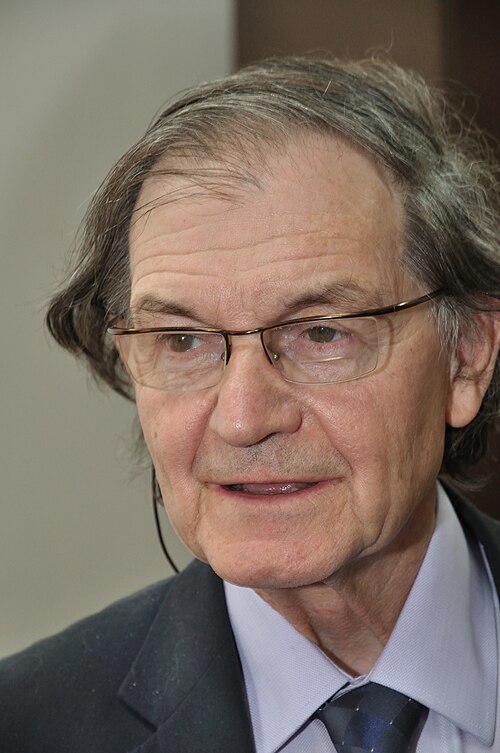
In 1965 Penrose introduced the idea of a trapped surface and used it to prove that once gravity pulls matter past a certain point, collapse to a singularity, and a black hole, becomes unavoidable. He showed this needs no perfect symmetry, so black holes are a generic result of Einstein's theory rather than a mathematical fluke.
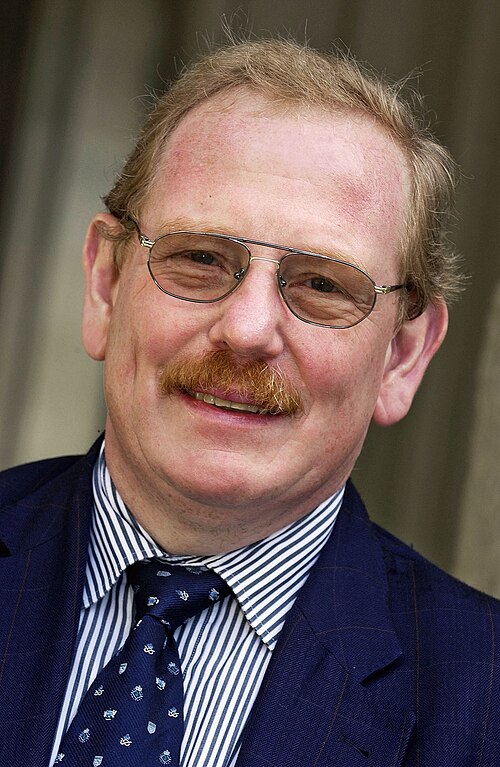
Genzel leads a group at the Max Planck Institute that used the European Southern Observatory's telescopes in Chile to track stars near the galactic centre for decades. His measurements pinned an enormous invisible mass into a tiny region of space.
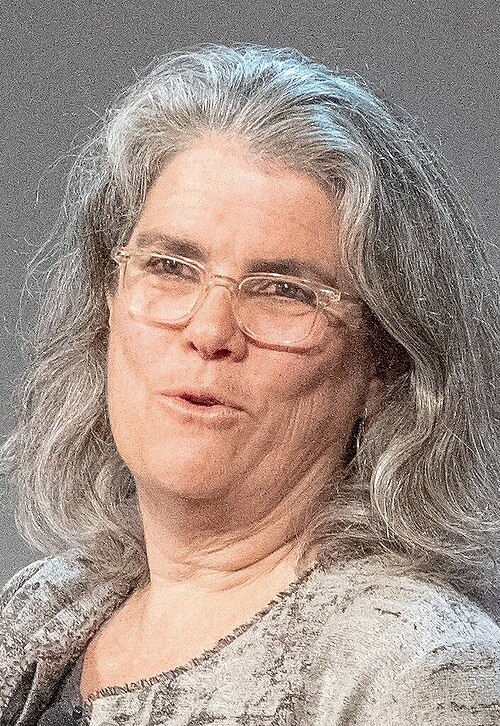
Ghez leads a separate group that used the Keck telescopes in Hawaii and pioneering adaptive optics to sharpen its view of the galaxy's core. Her independent measurements of the same stellar orbits matched Genzel's, which made the case for a supermassive black hole hard to dispute.
Sources
Facts are pinned from the official Nobel Prize API. The explanations were written from these sources: