Spooky action made real: how entangled photons settled Einstein's doubt
Awarded to Alain Aspect, John Clauser and Anton Zeilinger “for experiments with entangled photons, establishing the violation of Bell inequalities and pioneering quantum information science”.
1Pick your depth
What was the 2022 Nobel Prize in Physics awarded for?
The 2022 Physics prize answers a question that was once pure philosophy. Are two distant particles genuinely linked, or do they just carry hidden instructions fixed in advance? Alain Aspect, John Clauser and Anton Zeilinger measured entangled photons and showed the link is real, ruling out every local hidden variable explanation, and they turned that strangeness into the foundations of quantum information science.
2Guess first
You measure one of a pair of entangled photons and instantly learn something about its partner far away. Did your measurement send a signal to the other photon faster than light?
How close were you?
Einstein suspected the photons secretly carry instructions, fixed at birth, that decide every measurement. How could an experiment tell that story apart from genuine quantum entanglement?
How close were you?
3Learn it at ELI5
ELI5 done
Read the transcript
Anton Zeilinger was at home, working on a paper, when the phone brought news of his Nobel Prize. He was speechless. Imagine a machine throwing 2 balls in opposite directions. If one shows black, the other shows white. Albert Einstein suspected each ball hid a label that set its colour. Quantum physics says both stay grey until someone looks. John Clauser and Alain Aspect tested this with pairs of light particles. There was no hidden label. Anton says links like these will help future quantum computers talk to each other.
Undergrad done
Read the transcript
Before his PhD, Alain Aspect taught in Cameroon. In his free time, he taught himself quantum mechanics from a textbook. Back in France, he was ready for John Bell's paper. By 1982, Aspect could switch his measurement settings after entangled photons had left their source. Each switch had to happen within a few billionths of a second. His target was Einstein's suspicion that entangled particles carry hidden instructions. Bell showed that such instructions cap how strongly distant results can agree. In 1972, John Clauser and Stuart Freedman had measured correlations above that cap. Their filters sat at fixed angles, leaving a loophole for Aspect to close. Anton Zeilinger made entanglement a tool. In 1998, his group entangled 2 photons that had never met.
Expert done
Read the transcript
In 1970, John Clauser joined Charles Townes at Berkeley for radio astronomy. Carl Kocher's calcium photon-pair apparatus was still in the lab, and Townes let Clauser spend half his time on Bell tests. In 1969, Clauser had co-written the CHSH form of Bell's inequality. Local hidden variables keep its correlation sum S at or below 2. Quantum mechanics allows 2 root 2. With Stuart Freedman, he spent 2 years rebuilding Kocher's setup and about 200 hours taking data. Their 1972 violation stood at about 6 standard deviations. In 1982, Alain Aspect's acousto-optic switches flipped the photon paths about every 10 nanoseconds, with polarisers 12 metres apart. In 1998, Anton Zeilinger's group enforced strict locality at 400 metres. In 2006, Zeilinger's team sent entangled photons 144 kilometres between La Palma and Tenerife. They measured S at 2.508 and drew a secure key from the same run.
Imagine you split a pair of magic coins and mail one to a friend across the world. Whenever you flip yours and look, you instantly know how your friend's coin will land, every single time.
Einstein thought there had to be a hidden trick. Maybe the coins were secretly set up in advance, like two gloves packed into separate boxes. Open one box, find a left glove, and you know the other holds a right one. No magic, just instructions hidden inside.
How to catch a hidden trick
John Bell found a clever way to tell the two stories apart. If the coins carried hidden instructions, the matches between far-apart flips could only be so strong. Quantum particles match more strongly than that. So scientists measured tiny particles of light, called photons, and the matches were too strong for any hidden plan. The link is real.
Alain Aspect, John Clauser and Anton Zeilinger built the experiments that proved it, then used this strange link to start building powerful new tools.
Two particles can be linked so tightly that they behave like a single object, even when they sit far apart. Measure a property of one, and the matching property of the other is instantly fixed. This is entanglement. In 1935 Einstein, Podolsky and Rosen argued that this could not be the whole story. They suspected the particles simply carried hidden instructions, set when they were created, and that quantum mechanics was an incomplete description. Einstein called the alternative spooky action at a distance and did not believe it.
For thirty years this looked like a question for philosophers. Then in 1964 John Stewart Bell made it experimental. He showed that the hidden-instructions idea, known as a local hidden variable theory, puts a strict limit on how strongly two distant measurements can agree. Quantum mechanics predicts agreement beyond that limit. So the two pictures of reality make different, measurable predictions. You only have to count.
A line that hidden instructions cannot cross
A Bell inequality is a ceiling on correlation. Add up the matches between two detectors across several filter angles in a particular way, and any local hidden variable theory keeps the total at or below a fixed value. Entangled quantum particles push the total above it. Cross the line and you have ruled out every explanation built from local, pre-set instructions.
“Why this happens I haven't the foggiest. I have no understanding of how it works, but entanglement appears to be very real.”John Clauser, on the 2022 prize
Clauser ran the first real test in the early 1970s and saw the violation. Aspect tightened it by switching the filters while the photons were in flight. Zeilinger pushed it further with random settings and even starlight, and turned entanglement into working technology. Each step closed a possible loophole, a way a stubborn local explanation might still sneak through.
The sharpest version of Bell's argument is the CHSH inequality, named after Clauser, Horne, Shimony and Holt (1969). Each side picks one of two filter settings. Call Alice's choices a and a', and Bob's b and b'. For each pair you measure the correlation E between the two outcomes, then form the combination S = E(a,b) - E(a,b') + E(a',b) + E(a',b'). Any theory in which each particle carries pre-set values, and in which one side's setting cannot influence the other side's result, obeys |S| ≤ 2. This is the local hidden variable bound.
2 versus 2√2
Quantum mechanics, applied to a maximally entangled pair, predicts that S can reach 2√2 ≈ 2.83, a result called Tsirelson's bound. That is strictly above the classical ceiling of 2. The gap is the whole point. A measured S above 2 cannot be reproduced by any model in which outcomes are fixed in advance and the two wings stay independent. Aspect's 1982 photon experiment measured S near 2.7, many standard deviations clear of the limit, and later tests pushed the violation much higher.
How strong can the correlation get?
S combines the correlations from four filter settings. Local realism caps it at 2; quantum mechanics does not.
Ruling out local hidden variables rigorously means closing loopholes. The locality loophole asks whether one detector could have signalled its setting to the other before the result was recorded; you close it by choosing settings randomly and fast enough that no light-speed signal could cross the gap in time. Aspect switched settings while the photons were in flight, and Zeilinger's group used quantum random number generators with the detectors hundreds of metres apart. The detection loophole asks whether the photons that happen to be detected are a fair sample; you close it with high-efficiency detectors. The freedom-of-choice loophole asks whether the settings themselves were somehow predetermined; experiments have set them using light from distant stars and galaxies to make any conspiracy absurd.
Loophole-free tests
In 2015 three groups, in Delft, at NIST and in Vienna, closed the locality and detection loopholes in a single experiment for the first time. The only escape left is superdeterminism, the idea that the settings and the outcomes were jointly fixed at the beginning of the universe. Because it cannot be tested, most physicists treat the case as settled: nature is not both local and governed by pre-set values.
Entanglement as a resource
- Quantum cryptography: the same correlations that break a Bell inequality let two parties share a secret key whose security rests on physics, since any eavesdropper disturbs the entanglement.
- Quantum teleportation: Zeilinger's group first demonstrated it in 1997, transferring a particle's complete quantum state onto a distant particle using a shared entangled pair and a classical message. It moves quantum information without copying it.
- Entanglement swapping: two particles that never met can be entangled by a joint measurement on their partners, the building block of quantum repeaters and long-distance quantum networks.
- Quantum computing: entanglement between qubits is the resource that lets quantum computers represent and process information in ways no classical machine can match.
- No faster-than-light messaging: the correlations are instant, but each local result is random, so entanglement on its own cannot send a usable signal faster than light.
They used the light of distant stars to rule out a cosmic conspiracy
To attack the last escape route, the idea that the filter settings might somehow be predetermined, experimenters set the two measurement choices using light that left distant stars and galaxies long ago. For any hidden plan to fake the result, it would have had to be arranged long before the experiment existed. The inequality still broke.
4Check yourself
What does a measured Bell inequality violation actually prove?
In the prize-winning experiments, what were the entangled particles?
Why did Aspect switch each filter's setting while the photons were still in flight?
Key terms
- Entanglement
- A link between two or more particles so strong that they must be described as a single system. Measuring one instantly fixes the matching property of the other, however far apart they are.
- Bell inequality
- A limit, derived by John Bell, on how strongly the results of two distant measurements can be correlated if the world runs on local, pre-set instructions. Quantum entanglement breaks the limit.
- Local hidden variable theory
- The picture Einstein favoured: particles carry hidden, pre-set values that decide every measurement, and nothing travels faster than light. Bell tests rule this picture out.
- CHSH inequality
- The most-used form of Bell's inequality. It combines correlations from four filter settings into a number S that local hidden variable theories keep at or below 2, while entangled particles can reach about 2.83.
- Quantum teleportation
- Transferring the complete quantum state of one particle onto a distant particle, using a shared entangled pair plus an ordinary classical message. First demonstrated by Zeilinger's group in 1997.
- Loophole
- A gap in a Bell test that might let a local explanation survive, such as the detectors secretly signalling (locality) or detecting an unfair sample of photons (detection). Closing them all makes the result airtight.
The laureates
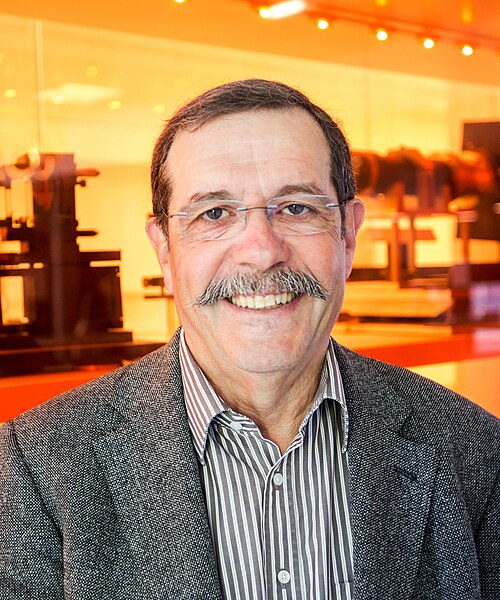
Born in Agen, France in 1947, Aspect sharpened Clauser's test. He built a brighter source of entangled photons and, crucially, switched the orientation of the filters while the photons were already in flight, so the two sides could not have agreed on an answer in advance. His 1982 experiments made the violation of Bell's inequality far harder to explain away.
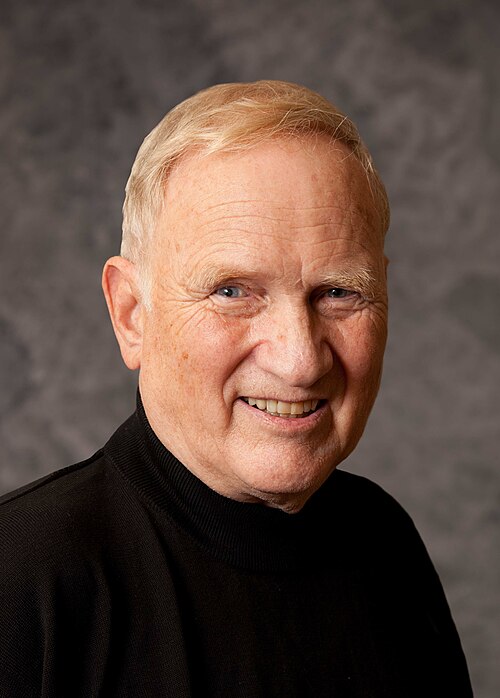
Born in Pasadena, USA in 1942, Clauser ran the first real test of a Bell inequality in the early 1970s with Stuart Freedman. He illuminated calcium atoms so they emitted pairs of entangled photons, set a polarisation filter on each side, and measured a clear violation. It was the first laboratory evidence that no local hidden variable theory could explain the correlations.
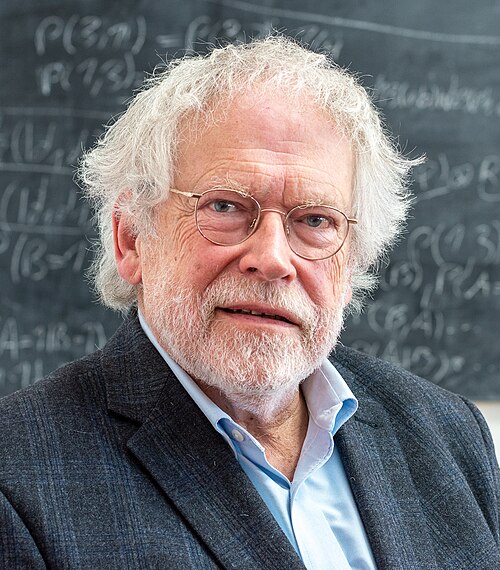
Born in Ried im Innkreis, Austria in 1945, Zeilinger pushed Bell tests to new precision, generating entangled pairs by shining a laser on a special crystal and choosing each filter's setting with quantum random numbers, even using light from distant stars. He also led the first demonstration of quantum teleportation in 1997, turning entanglement into a working tool for quantum information.
Sources
Facts are pinned from the official Nobel Prize API. The explanations were written from these sources: