One circuit that behaves like a single quantum particle
Awarded to John Clarke, Michel H. Devoret and John M. Martinis “for the discovery of macroscopic quantum mechanical tunnelling and energy quantisation in an electric circuit”.
1Pick your depth
What was the 2025 Nobel Prize in Physics awarded for?
The 2025 Physics prize honours an experiment that caught quantum behaviour in an object big enough to hold in your hand. John Clarke, Michel Devoret and John Martinis built a superconducting circuit in which billions of paired electrons act together as one quantum object. That object tunnels through an energy barrier as a single unit and takes in energy only in fixed steps, just like an atom, which is the principle behind today's superconducting quantum computers.
2Guess first
Tunnelling lets a tiny particle slip through a barrier it should not be able to cross. Everyone agreed it works for a single electron. The laureates asked a bolder question: could a whole electric circuit, something you can hold, do the same trick? What did they find?
How close were you?
If you keep cooling a trapped system, a classical escape over a barrier should get slower and slower, then stop. The laureates cooled their circuit below 50 millikelvin and watched how often it escaped. What told them this was quantum, not just heat?
How close were you?
3Learn it at ELI5
ELI5 done
Read the transcript
At 2 in the morning, John Clarke's phone rang. It was Sweden, with big news. A ball thrown at a wall bounces back. A tiny particle can sometimes pop out on the other side. In the 1980s, Clarke, Michel Devoret and John Martinis cooled a small circuit until its electrons moved as one. Then the whole circuit slipped through its wall, and a tiny voltage showed it. Their circuit sat on a chip about 1 centimetre across. Their discovery won the 2025 Nobel Prize in Physics.
Undergrad done
Read the transcript
In a second basement at Berkeley, a PhD student and a postdoc argued so hard that passers-by wondered what was going on. They were John Martinis and Michel Devoret, in John Clarke's group. Their first run was a complete disaster. It was really a microwave experiment, so they rebuilt it with heavy filtering and a much colder fridge. In a superconductor, Cooper pairs share one wave function. So the phase across a Josephson junction acts like one particle, trapped where current flows with no voltage. That particle escaped by tunnelling, and a voltage appeared. Microwaves lifted it to higher energy levels, in fixed steps like an atom's. Martinis later used the lowest 2 of those levels as the 0 and 1 of a quantum bit.
Expert done
Read the transcript
John Martinis cooled a chip built for higher current and watched the oscilloscope. Where one band of switching events should have been, he saw 3 peaks. Earlier claims of macroscopic quantum tunnelling were murky. Stray microwave noise could fake the low-temperature plateau in the escape rate. The Berkeley group of John Clarke, Michel Devoret and Martinis built copper powder filters with over 200 decibels of damping. They measured every junction parameter independently, so the theory had nothing to fit. The junction phase, shared by billions of Cooper pairs, sits in a tilted washboard potential. Below the crossover temperature, it tunnelled out at the predicted rate. Driven at 2 gigahertz, it escaped from 3 excited levels, spaced like a single quantum particle's. In 1988 the group described the junction as a macroscopic nucleus, big enough to get one's grubby fingers on.
Some particles are so small they can do something that looks impossible. An electron can slip straight through a wall that should stop it, a move called tunnelling. Until now, tunnelling had only ever shown up in single, invisibly small particles.
The prize winners built a small electric circuit and cooled it colder than deep space. Inside, trillions of electrons paired up and moved in perfect step, like a whole crowd swaying as one. Because they moved together, the entire circuit began to act like a single tiny particle, even though it was big enough to hold.
The whole circuit did the trick
The circuit slipped through an energy barrier all at once, as one object, and a voltage appeared to show it had escaped. It could also take in energy only in fixed jumps, never in between, just like a single atom.
That was the shock. Quantum rules people thought belonged only to the invisibly small were caught working in something large. The same trick now sits at the heart of superconducting quantum computers.
To find quantum behaviour in something large, start with superconductivity. When certain metals are cooled below a critical temperature, their electrons pair up into Cooper pairs, and all those pairs fall into a single shared quantum state. The whole sea of electrons now moves in lockstep and can be described by one wavefunction with a single phase.
Now take two superconductors and separate them with an insulating barrier thin enough for Cooper pairs to cross. This is a Josephson junction. Feed a small current through it and, up to a point, that current flows with no voltage at all. Physicists call this the zero-voltage state, and you can picture the circuit as a ball resting at the bottom of a valley, trapped behind a hill.
The whole circuit escapes at once
A classical ball stays in the valley unless something kicks it over the hill, and cooling the circuit should make escapes rarer and rarer. Instead, below about 50 millikelvin, the laureates saw the circuit keep leaving the zero-voltage state at a steady rate that no longer depended on temperature. The only explanation was tunnelling: the entire circuit, acting as one quantum object, passed straight through the barrier. Each escape showed up as a sudden voltage.
How big is the 'single' quantum object?
Tunnelling was thought to belong to the very small. Here a vast collective acts as one.
They went further and showed the trapped state has quantised energy levels, like the rungs of a ladder. Shining microwaves on the junction, they found it absorbed energy only at certain frequencies, hopping to a higher rung, exactly as an atom absorbs light only at its own special colours. A circuit big enough to hold was behaving like a single artificial atom.
Tunnelling is normally a single-particle story. A lone electron, described by one wavefunction, has a small but real chance of passing through a barrier that classical physics forbids. The laureates asked whether an entire electric circuit could be coaxed into doing the same thing. The key is superconductivity. Below its critical temperature a superconductor's conduction electrons bind into Cooper pairs, each carrying charge 2e, and all the pairs condense into a single macroscopic wavefunction with one shared phase. The circuit's quantum state is then set not by countless individual electrons but by one collective coordinate.
Two superconductors, one phase
A Josephson junction is two superconductors separated by a barrier thin enough for Cooper pairs to cross. Brian Josephson predicted in 1962 that a supercurrent flows across it, fixed by the difference in phase between the two superconducting wavefunctions. That single number, the phase difference, is the macroscopic degree of freedom the laureates studied. Bias the junction with a current and the phase behaves like a particle with a definite mass, set by the junction's capacitance, sitting in a tilted washboard potential of the form minus the Josephson energy times the cosine of the phase, minus a tilt from the bias current.
In that tilted-washboard picture the zero-voltage state is the phase trapped in one local well: current flows with no voltage across the junction. Classically the only way out is to be kicked over the barrier by thermal energy, so the escape rate should fall off as exp(minus barrier over kT) and vanish as the circuit is cooled. Clarke, Devoret and Martinis cooled their junction below about 50 millikelvin and found the opposite. The escape rate flattened out and stayed constant, independent of temperature. The phase was not climbing the barrier. The whole collective coordinate was tunnelling straight through it, and each escape announced itself as a sudden voltage across the junction.
An artificial atom on a chip
A trapped well does not hold a continuum of states. It holds a ladder of discrete, quantised energy levels, just like an atom. The team confirmed this by driving the junction with microwaves of different frequencies. The circuit absorbed energy only at specific frequencies that matched the spacing between levels, jumping to a higher rung. Because higher rungs sit closer to the top of the barrier, they tunnelled out faster, so the zero-voltage state lived for a shorter time when the circuit held more energy. Their 1985 paper reported this energy-level quantisation directly.
What made this macroscopic was the number of particles moving as one. Billions of electrons, paired and condensed, acted through a single quantum variable that could be prepared, tunnelled and measured. This answered a question pressed by Anthony Leggett: how large can a system be and still obey quantum mechanics? The answer turned out to be large enough to hold in your hand.
Why the experiment still matters
- A current-biased Josephson junction is a controllable artificial atom. Its energy levels are unevenly spaced, so two of them can be singled out and used as a quantum bit.
- Superconducting qubits built on Josephson junctions are now one of the leading platforms for quantum computing, used by groups including Google and IBM. Devoret and Martinis went on to lead this hardware work.
- The precise link between voltage and frequency in a Josephson junction defines the modern standard for the volt.
- The experiments turned macroscopic quantum mechanics from a thought experiment into something engineers measure and build with.
Quantum weirdness you could hold in your hand
Quantum tunnelling and quantised energy levels were thought to belong to single atoms and electrons. The laureates demonstrated both in an electrical circuit big enough to be held in the hand, where billions of paired electrons acted as one quantum object. It is one of the largest systems ever caught obeying the strange rules of the quantum world.
4Check yourself
What plays the role of the single 'particle' in the laureates' circuit?
How did the team confirm the escape from the zero-voltage state was quantum tunnelling rather than ordinary thermal escape?
Why does this 1980s experiment matter for technology today?
Key terms
- Superconductivity
- A state in which a cooled material carries electric current with no resistance, because its electrons join into pairs that share one quantum state.
- Cooper pair
- Two electrons bound together inside a superconductor. All the pairs condense into a single collective quantum state, which is why the whole circuit can act as one object.
- Josephson junction
- Two superconductors separated by a barrier thin enough for Cooper pairs to cross. The current across it is set by the phase difference between the two superconductors.
- Macroscopic quantum tunnelling
- Tunnelling through an energy barrier performed not by a single particle but by a large collective variable, such as the phase of an entire superconducting circuit.
- Energy quantisation
- The fact that a trapped system can hold only specific, discrete amounts of energy, like rungs on a ladder, rather than any value in between.
- Qubit
- The basic unit of a quantum computer. A Josephson junction's two lowest energy levels can serve as one, which is the technology this discovery made possible.
The laureates
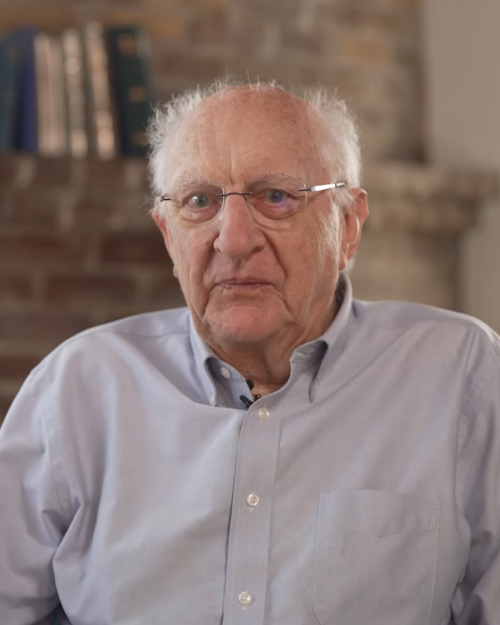
John Clarke, born in the United Kingdom in 1942, led the laboratory at the University of California, Berkeley where the experiments were carried out. He earned his doctorate at Cambridge and spent his career studying superconductors and the Josephson junction, the tools that made the discovery possible.
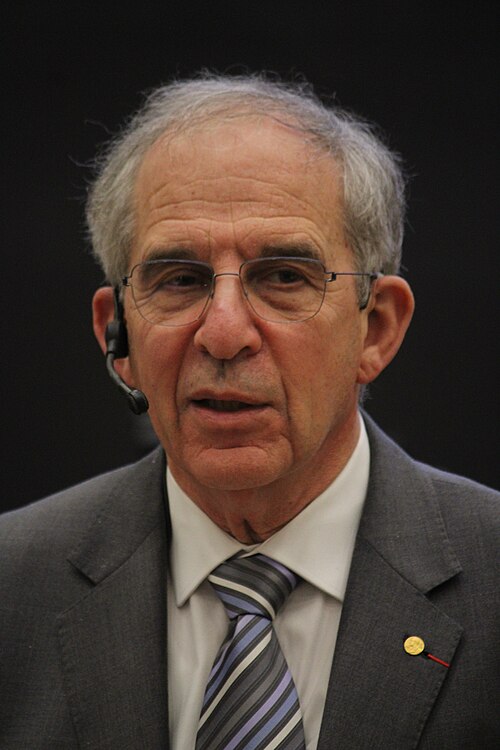
Michel H. Devoret, born in Paris, France in 1953, was a postdoctoral researcher in Clarke's group during the experiments. He went on to build superconducting quantum circuits at Yale University and the University of California, Santa Barbara, and now leads quantum hardware work at Google Quantum AI.
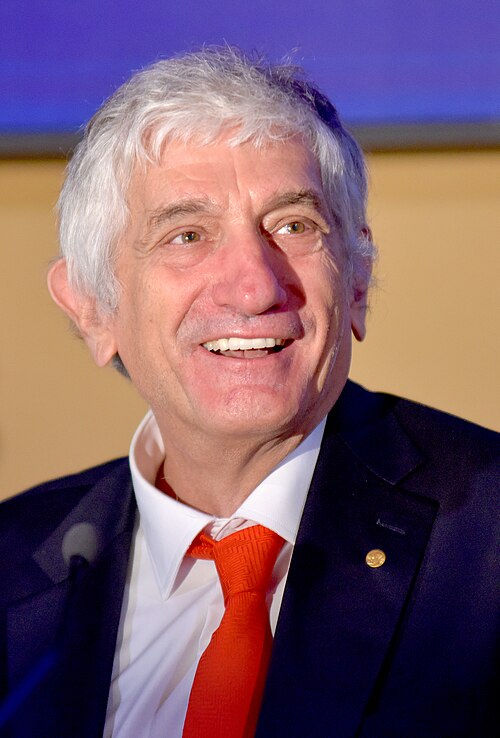
John M. Martinis, born in 1958, was a PhD student in Clarke's group and carried out much of the experimental work. He later became a professor at the University of California, Santa Barbara and built superconducting quantum processors, helping turn the discovery into a computing technology.
Sources
Facts are pinned from the official Nobel Prize API. The explanations were written from these sources: